Residue Class Lattice Set $A_{N,a}$
Definition
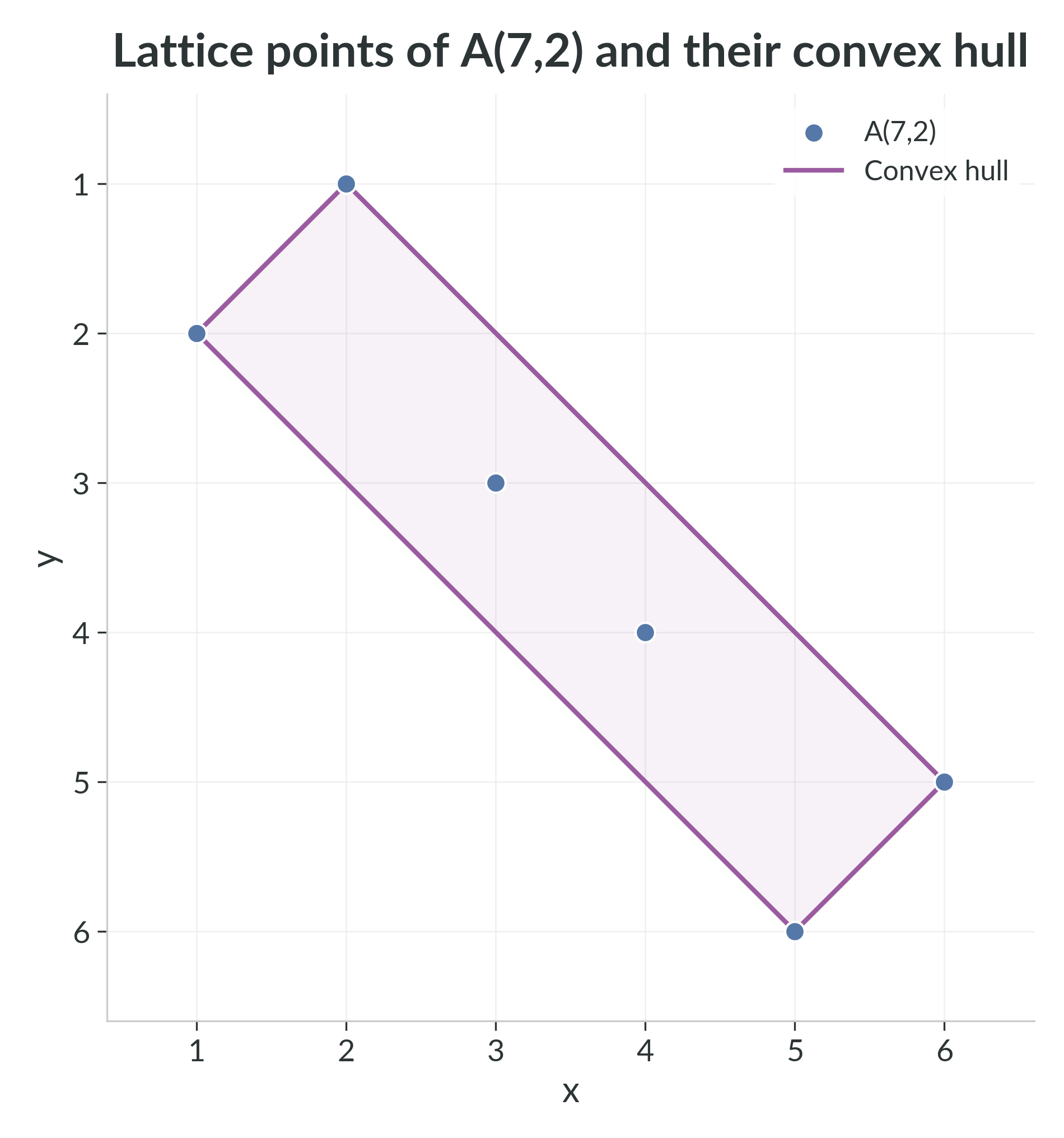
For $0 \le a \le N-1$, $$ A_{N,a} = \{(x,y) \in \{1,\ldots,N-1\}^2 : xy \equiv a \pmod{N}\}. $$ The collection $\{A_{N,0},\ldots,A_{N,N-1}\}$ partitions the full grid $\{1,\ldots,N-1\}^2$ according to the residue of the product $xy$ modulo $N$.
This is the basic finite object of the subject. The later geometry is built on top of it rather than replacing it.
What grows out of this set
From A_N_a one passes to several increasingly structured objects:
- the convex hull and its area S_N_a
- the total sum S_N
- the boundary-layer subsets first_boundary_model and second_boundary_model
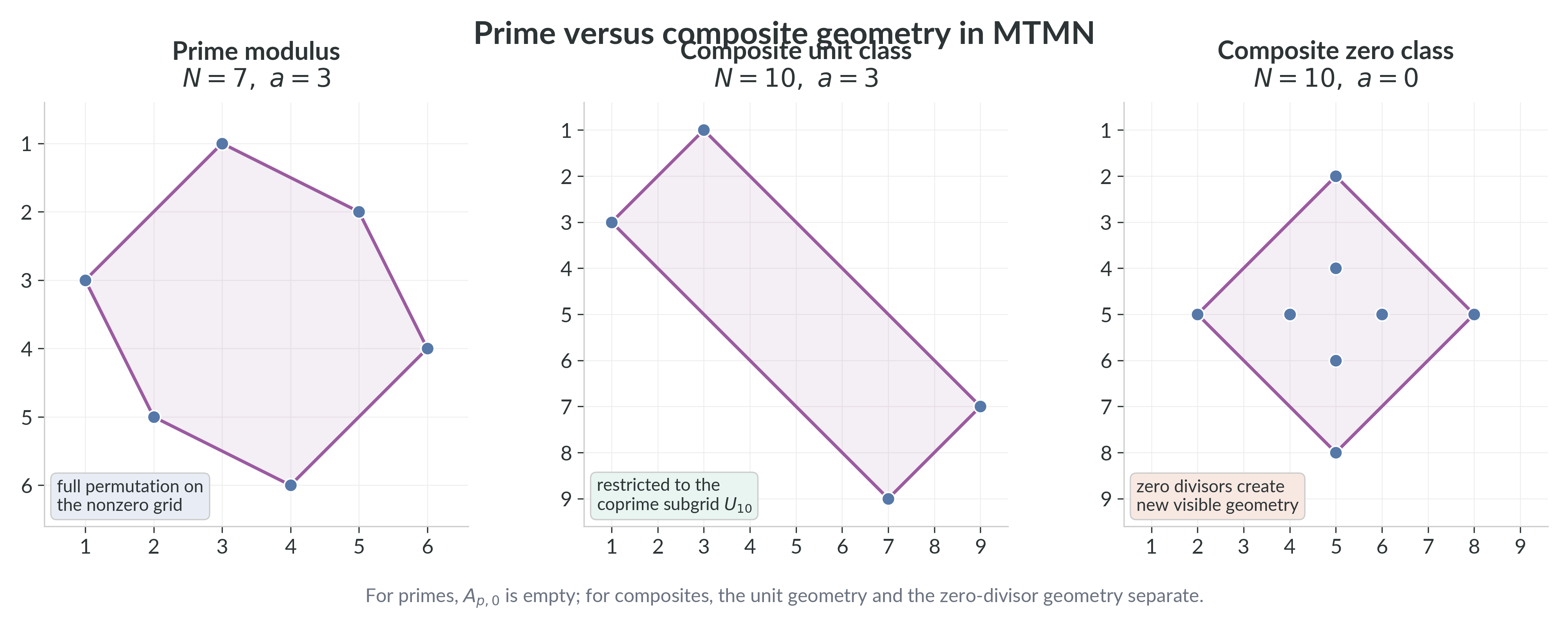
- the prime/unit-side permutation picture in the coprime regime
- the composite zero-divisor geometry zero_class_geometry
Unit side versus zero-divisor side
If $\gcd(a,N)=1$, then every point of $A_{N,a}$ lies on the coprime subgrid $$ U_N := \{u \in \{1,\ldots,N-1\} : \gcd(u,N)=1\}, $$ and in fact $$ A_{N,a} = \{(x, ax^{-1} \bmod N) : x \in U_N\}. $$ So coprime residues already give permutation plots on the coprime subgrid; in the prime case this becomes the whole nonzero grid.
The zero residue behaves differently. If $N$ is prime, then $A_{N,0}$ is empty. If $N$ is composite, then $A_{N,0}$ is nonempty, and the full hull is solved in zero_class_geometry, together with the sharp criterion $$ S(N,0)=0 \iff N \text{ is prime or } N=4. $$
Figures
Related Concepts
- MTMN — the table whose level sets are the residue classes
- modular_hyperbolas — literature term for the congruence-defined sets
- S_N_a — convex-hull area of $A_{N,a}$
- S_N — total area sum
- zero_class_geometry — exact composite-side geometry of $A_{N,0}$
- first_boundary_model — outer-layer approximation
- second_boundary_model — second-layer approximation
Tags
#definition