Total Area Sum $S(N)$
Definition
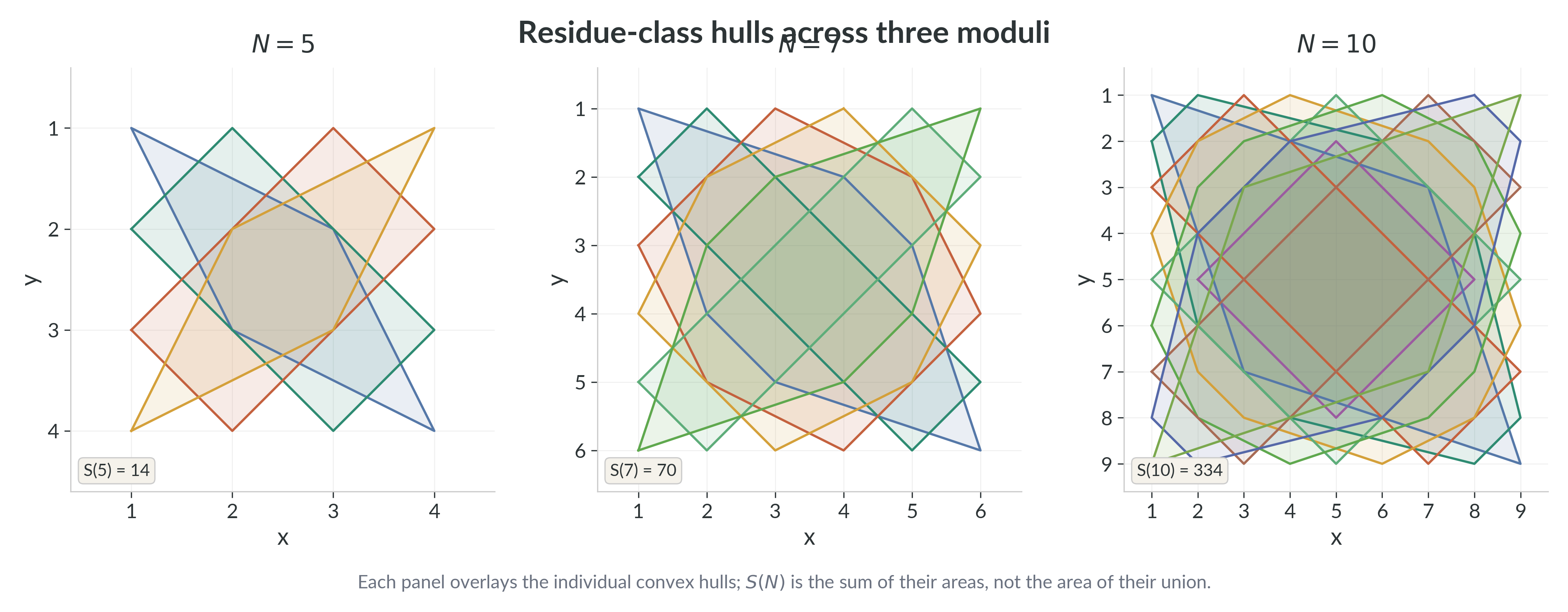
$$ S(N) = \sum_{a=0}^{N-1} S(N,a). $$ This is the simplest scalar summary of the full residue-area profile.
What is already known
- Every S_N_a is a nonnegative integer, so $S(N)$ is a nonnegative integer.
- Exact small values are already visible in the first worked examples and tables for small moduli.
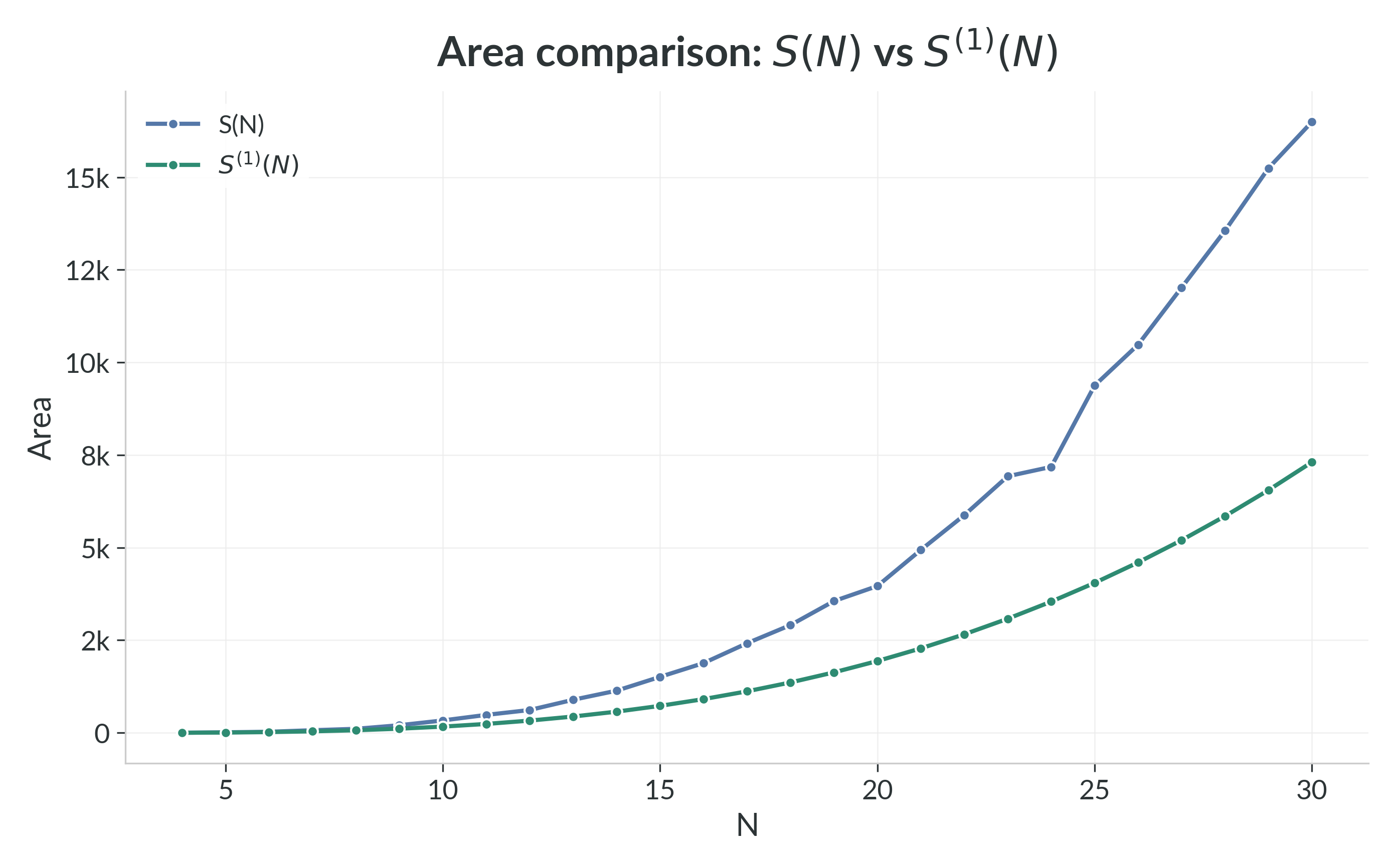
- The boundary models first_boundary_model and second_boundary_model give exact cubic lower models.
- One always has the rigorous cubic bracket $$ \frac{(N-3)(N-2)(N-1)}{3} \leq S(N) \leq N(N-2)^2. $$ So the exponent $3$ is already forced at the level of order of magnitude.
- The series $$ \sum_{N=4}^{\infty} \frac{1}{S(N)} \qquad\text{and}\qquad \sum_{N=4}^{\infty} \frac{N}{S(N)} $$ both converge by comparison with the first-boundary series.
Small exact values
| $N$ | $S(N)$ |
|---|---|
| 4 | 2 |
| 5 | 14 |
| 6 | 28 |
| 7 | 70 |
| 8 | 108 |
| 9 | 205 |
| 10 | 334 |
For the residue-by-residue tables behind these totals, see S_N_a and small_examples_atlas.
Growth and arithmetic sensitivity
The current proved global statement is the cubic-order theorem $$ S(N)=\Theta(N^3), $$ coming from the exact first-boundary lower model together with the square-window upper bound. The solved zero class in zero_class_geometry shows directly that zero-divisor geometry contributes in a mathematically rigid way to the total.
Figures
Related Concepts
- S_N_a — individual residue-class areas
- small_examples_atlas — first exact totals in small moduli
- first_boundary_model — exact cubic lower model $S^{(1)}(N)$
- second_boundary_model — exact odd-$N$ second-layer lower model
- zero_class_geometry — solved contribution from the zero residue
Tags
#definition #formula #theorem