Modular Hyperbolas
Literature term
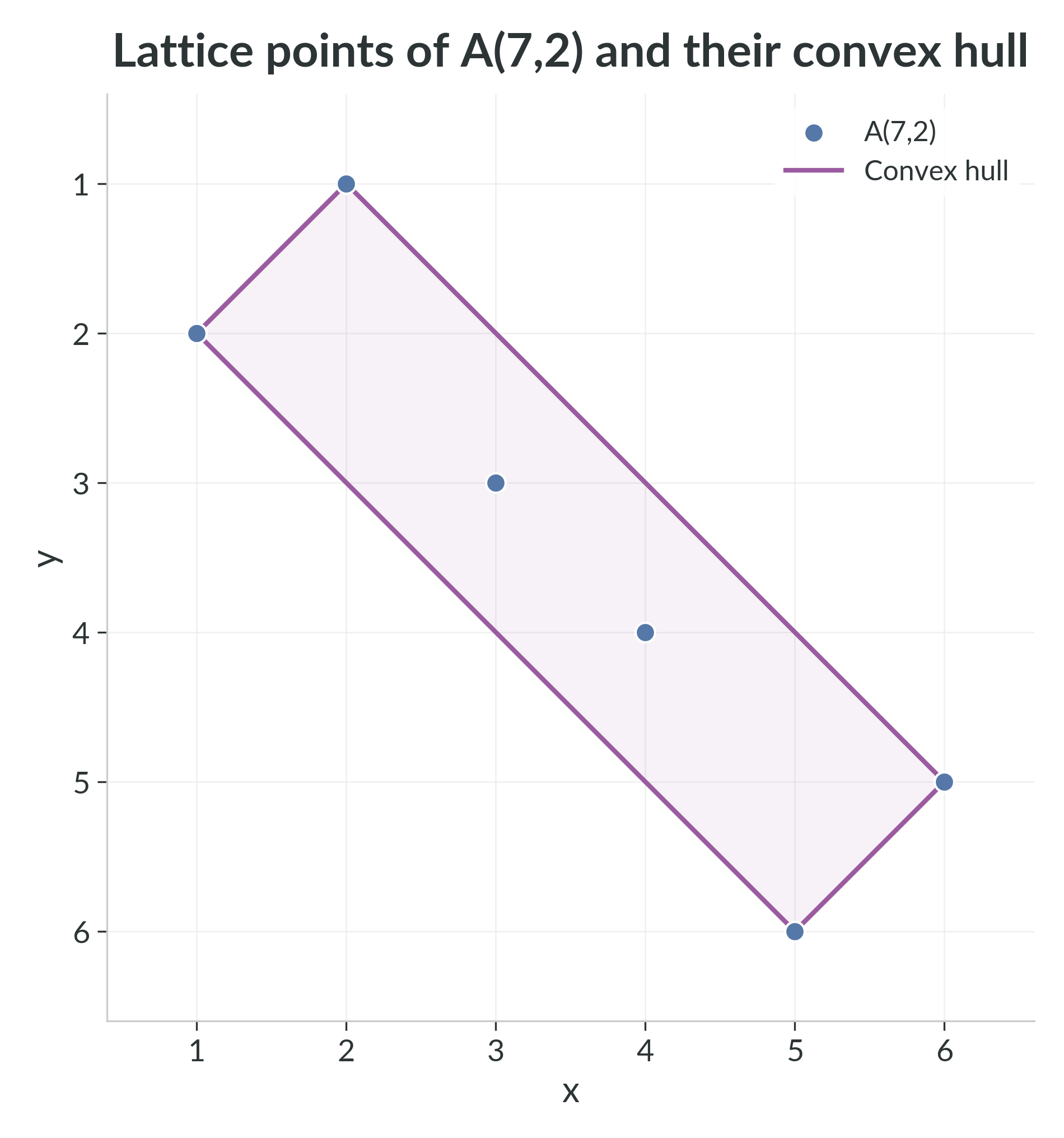
The congruence $$ xy \equiv a \pmod N $$ defines what the number-theory literature often calls a modular hyperbola.
Inside the positive-integer window $\{1,\ldots,N-1\}^2$, this is exactly the residue-class set A_N_a.
Why this page exists
This term is useful as a literature bridge, but it does not replace the MTMN viewpoint.
- A single modular hyperbola corresponds to one residue class A_N_a.
- MTMN studies the whole family $\{A_{N,a}\}_{a=0}^{N-1}$ simultaneously inside one multiplication table.
- The present project adds convex-hull areas S_N_a and the total sum S_N to that older congruence-set viewpoint.
So the phrase “modular hyperbola” names an important ingredient of the subject, while MTMN names the larger geometric program built from all residue classes together.
Prime and composite behavior
For unit residues, modular hyperbolas live on the coprime subgrid and become permutation plots in the prime case. For the zero residue, the prime/composite split is immediate:
- if $p$ is prime, then $A_{p,0} = \varnothing$
- if $N$ is composite, then $A_{N,0} \neq \varnothing$
This is why the MTMN story separates quickly into a clean prime-side picture and the more arithmetic composite-side zero-class geometry treated in zero_class_geometry.
Figure
Related Concepts
- A_N_a — the residue-class lattice set itself
- MTMN — studies all residue classes together
- S_N_a — area of the convex hull of one modular hyperbola
- zero_class_geometry — exact composite-side zero-class geometry
Tags
#definition