Zero-Class Hyperbola Gap
Why this page matters
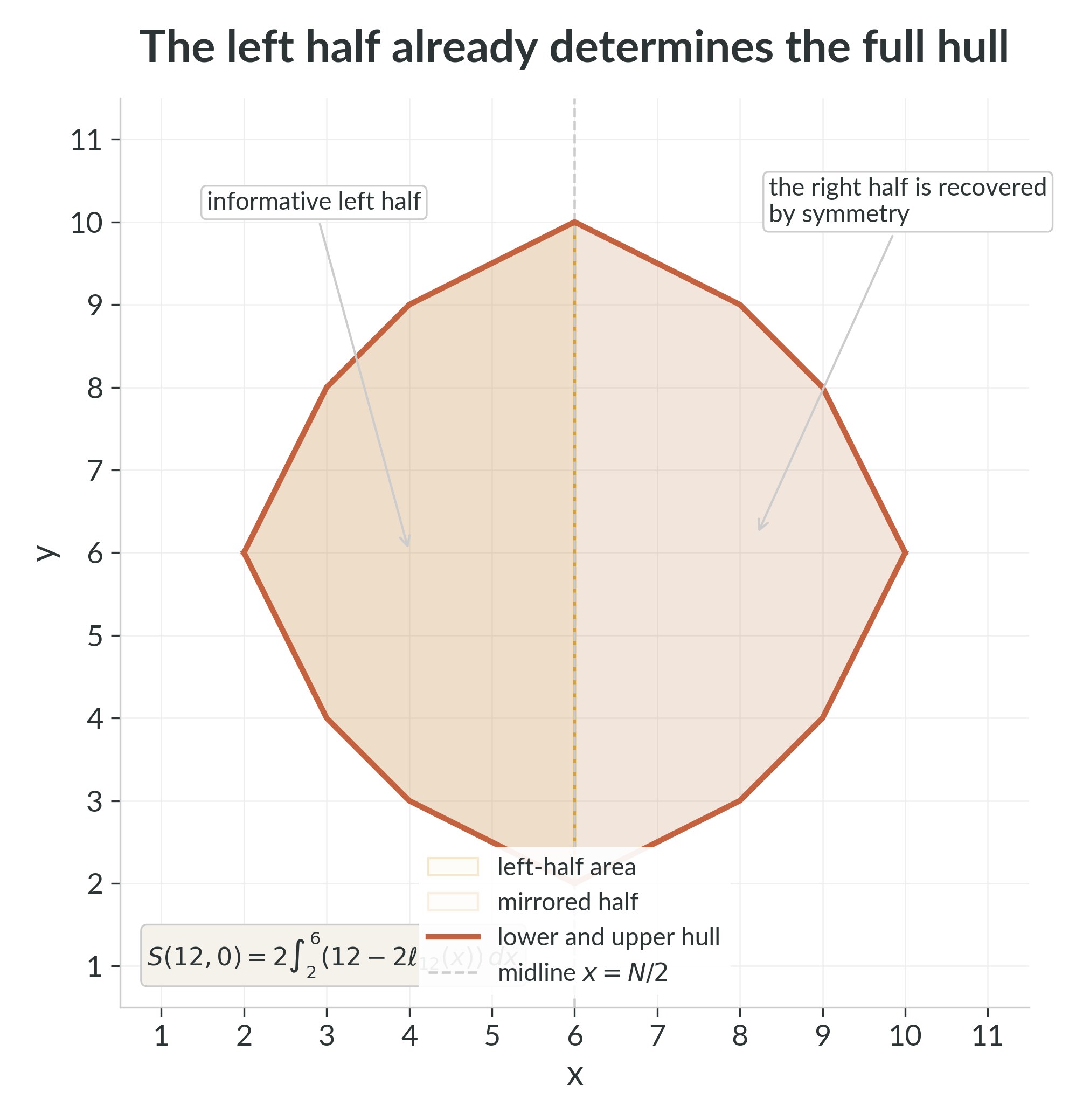
zero_class_geometry solves the zero-class hull exactly: the lower boundary is the polygonal divisor envelope $y=\ell_N(x)$, and the full area is $$ S(N,0)=\int_p^{N-p}\bigl(N-2\ell_N(x)\bigr)\,dx. $$
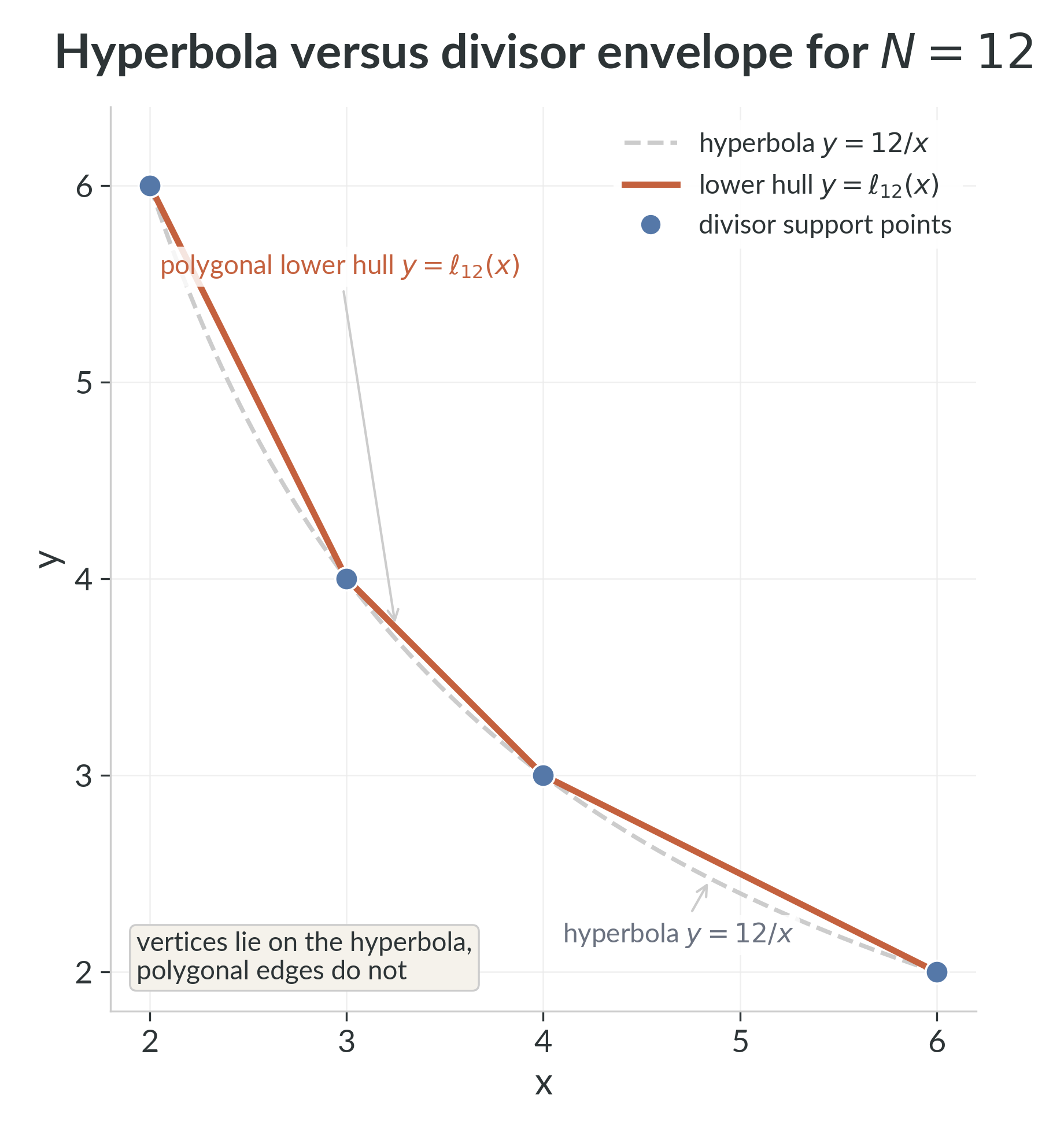
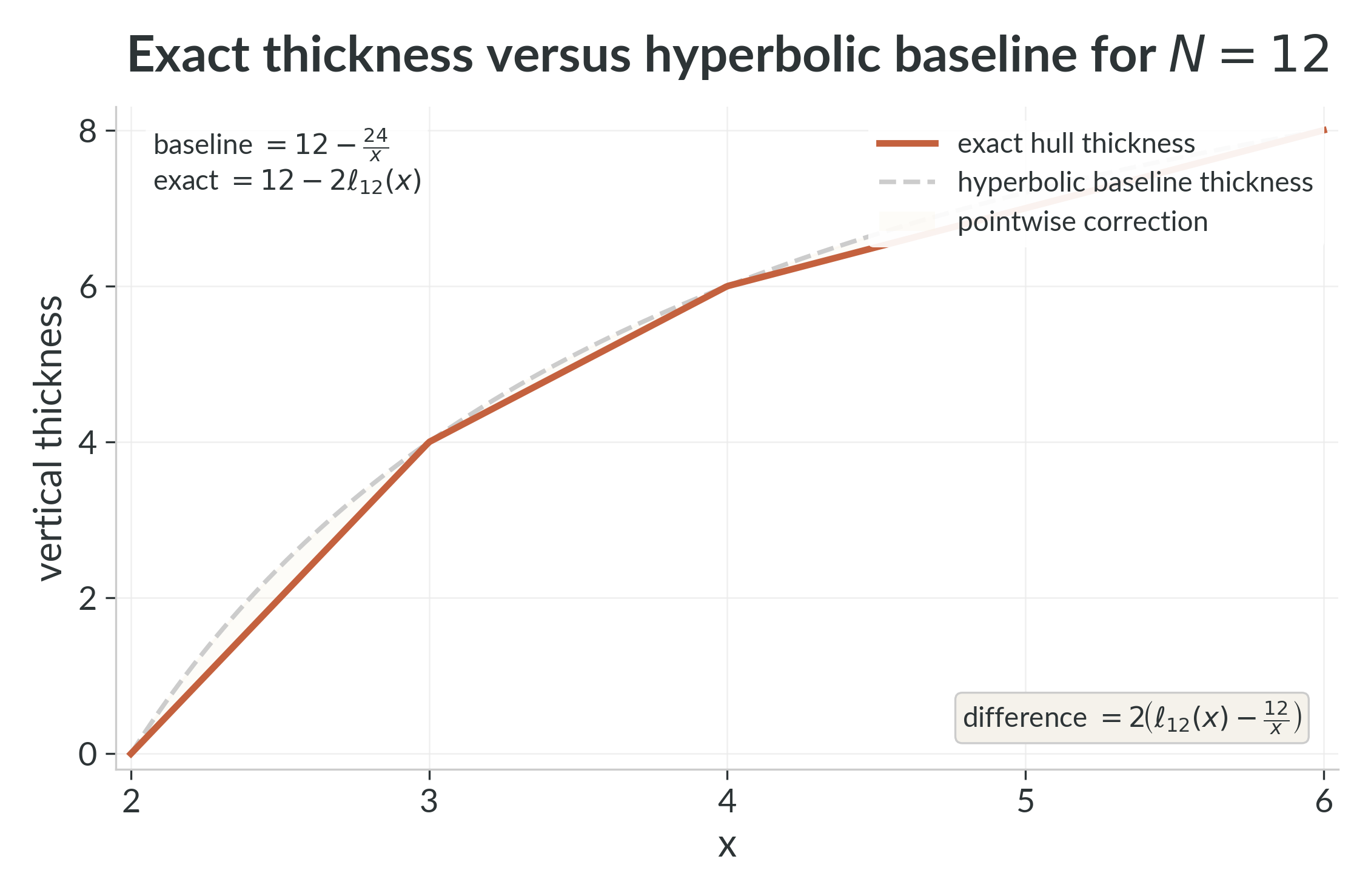
The same divisor support points also lie on the continuous hyperbola $$ y=\frac{N}{x}. $$ So the natural next question is not whether the hyperbola appears, but how far the exact divisor polygon sits above that smooth curve.
Setup
Assume that $N$ is composite, and let $$ p:=\min\{d>1:d\mid N\} $$ be the smallest proper divisor. Write $\ell_N(x)$ for the lower-hull function from zero_class_geometry.
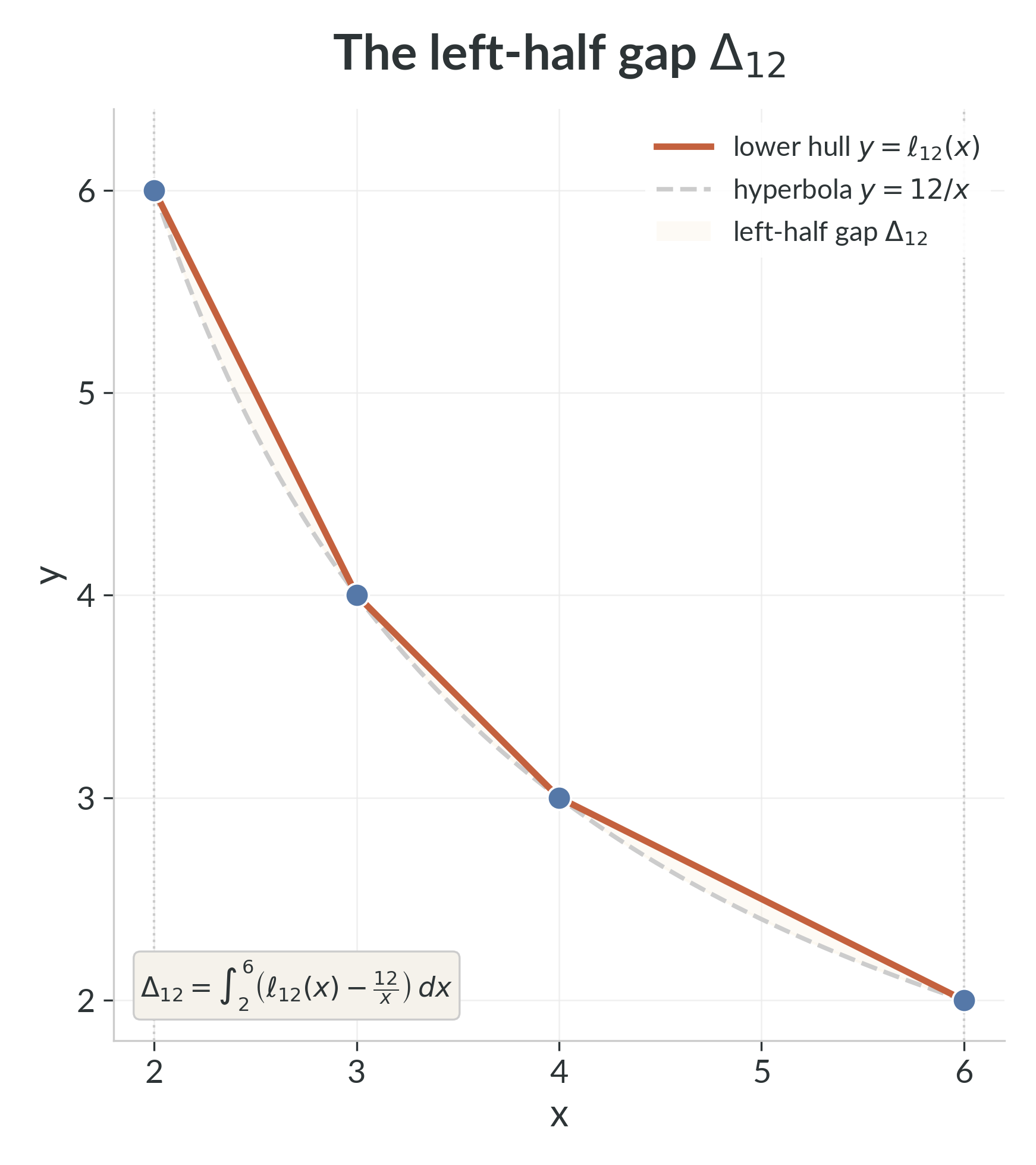
This order of subtraction is the right one because the graph of $y=N/x$ is convex on $x>0$. Secant lines between sampled divisor points therefore lie above the curve, and the lower hull is built from exactly those secants. Hence $$ \ell_N(x)\ge \frac{N}{x} $$ on the informative left half, so $$ \Delta_N\ge 0. $$
In plain language, $\Delta_N$ is the area between the smooth hyperbola and the polygonal arithmetic model.
Piecewise decomposition
Let
$$
p=x_1 So the full gap is the sum of the smaller regions trapped between each hull segment and the hyperbola. When both endpoints are genuine divisor vertices,
$$
\left(d_j,\frac{N}{d_j}\right),\qquad \left(d_{j+1},\frac{N}{d_{j+1}}\right),
$$
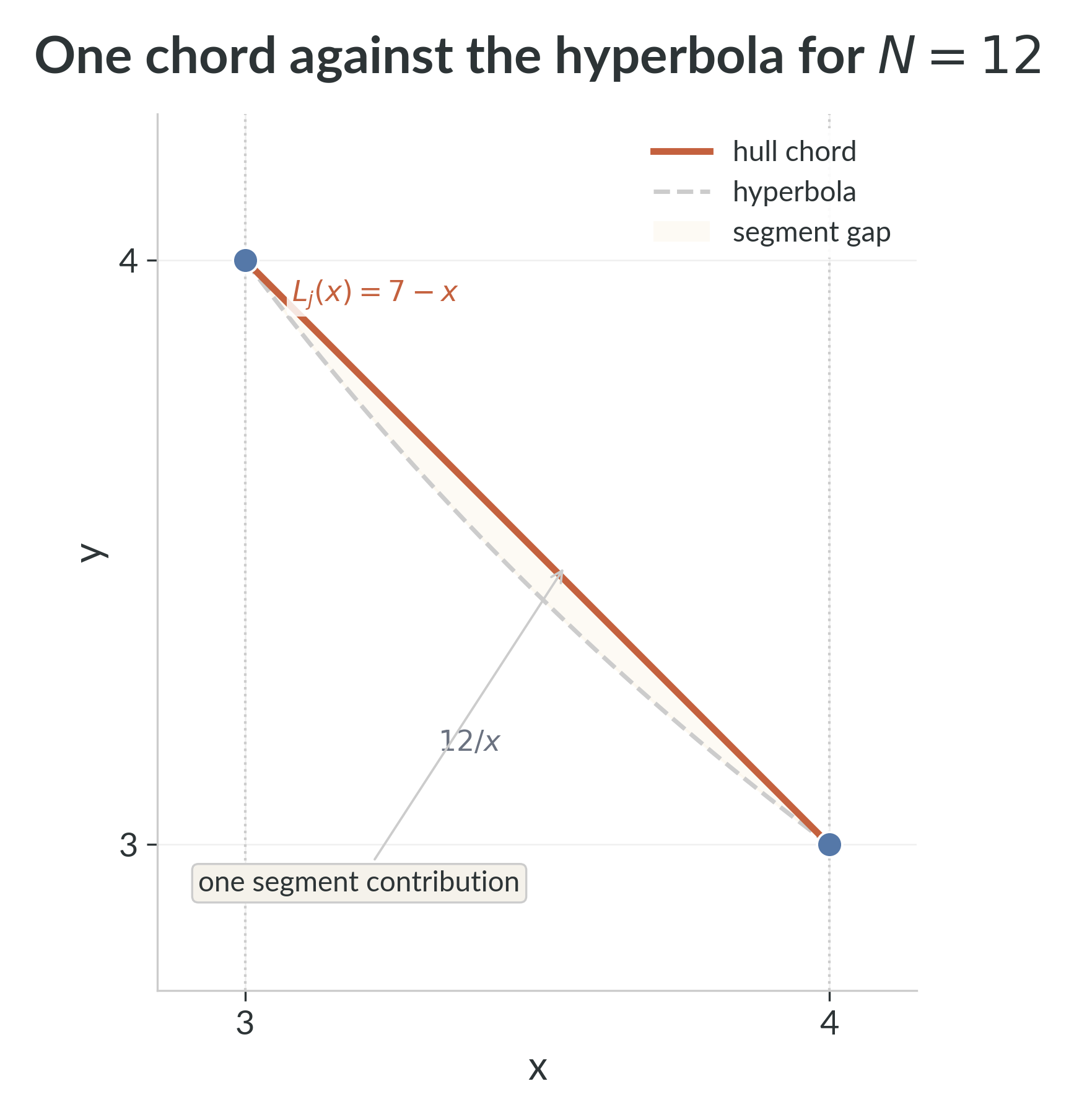
the segment is
$$
L_j(x)
=
\frac{N}{d_j}
+
\frac{\frac{N}{d_{j+1}}-\frac{N}{d_j}}{d_{j+1}-d_j}(x-d_j),
$$
and one gets the closed form
$$
\int_{d_j}^{d_{j+1}}\left(L_j(x)-\frac{N}{x}\right)\,dx
=
\frac{d_{j+1}-d_j}{2}\left(\frac{N}{d_j}+\frac{N}{d_{j+1}}\right)
-N\ln\left(\frac{d_{j+1}}{d_j}\right).
$$ This is trapezoid area minus logarithmic hyperbola area. If
$$
r_j:=\frac{d_{j+1}}{d_j},
$$
then the same divisor-to-divisor contribution becomes
$$
N\,F(r_j),
\qquad
F(r):=\frac{r-1}{2}\left(1+\frac{1}{r}\right)-\ln r.
$$ So the local gap depends only on the ratio of successive divisor abscissas, scaled by $N$. The interpretation is important: So the exact zero-class area is a smooth baseline minus an arithmetic polygonal correction. The left lower-hull vertices are
$$
(2,6),\ (3,4),\ (4,3),\ (6,2).
$$
Hence
$$
\ell_{12}(x)=10-2x \quad (2\le x\le 3),
$$
$$
\ell_{12}(x)=7-x \quad (3\le x\le 4),
$$
$$
\ell_{12}(x)=5-\frac{x}{2} \quad (4\le x\le 6).
$$ Therefore
$$
\Delta_{12}
=
\int_2^3\left(10-2x-\frac{12}{x}\right)\,dx
+
\int_3^4\left(7-x-\frac{12}{x}\right)\,dx
+
\int_4^6\left(5-\frac{x}{2}-\frac{12}{x}\right)\,dx.
$$ Evaluating gives
$$
\Delta_{12}
=
\left(5-12\ln\frac{3}{2}\right)
+
\left(\frac{7}{2}-12\ln\frac{4}{3}\right)
+
\left(5-12\ln\frac{3}{2}\right)
=
\frac{27}{2}-12\ln 3.
$$ The baseline term is
$$
H_{12}:=12(12-4)-48\ln 3=96-48\ln 3.
$$
So
$$
S(12,0)=H_{12}-4\Delta_{12}=42,
$$
which agrees exactly with the earlier hull computation in zero_class_geometry.Ratio form
Exact relation with $S(N,0)$
Worked example: $N=12$
Figures
Related Concepts
- zero_class_geometry — full divisor-rectangle and lower-envelope description
- S_N_a — the area function whose zero-class term is being decomposed
Tags
#theorem #formula