Zero-Class Geometry
Why this page matters
The zero residue class is the first place where the composite side of MTMN becomes completely geometric rather than merely existential. Chapter 5 of the book now gives a solved description of its hull in terms of divisors of $N$.
This page gathers that theorem package in one place: the zero-class degeneracy criterion, the divisor rectangles, the lower edge of the hull, and the resulting exact area formulas.
Step 1: when is the zero class degenerate?
The first resolved statement is: $$ S(N,0)=0 \iff N \text{ is prime or } N=4. $$ So for every composite modulus $N>4$, the zero class already has positive area.
Step 2: divisor rectangles
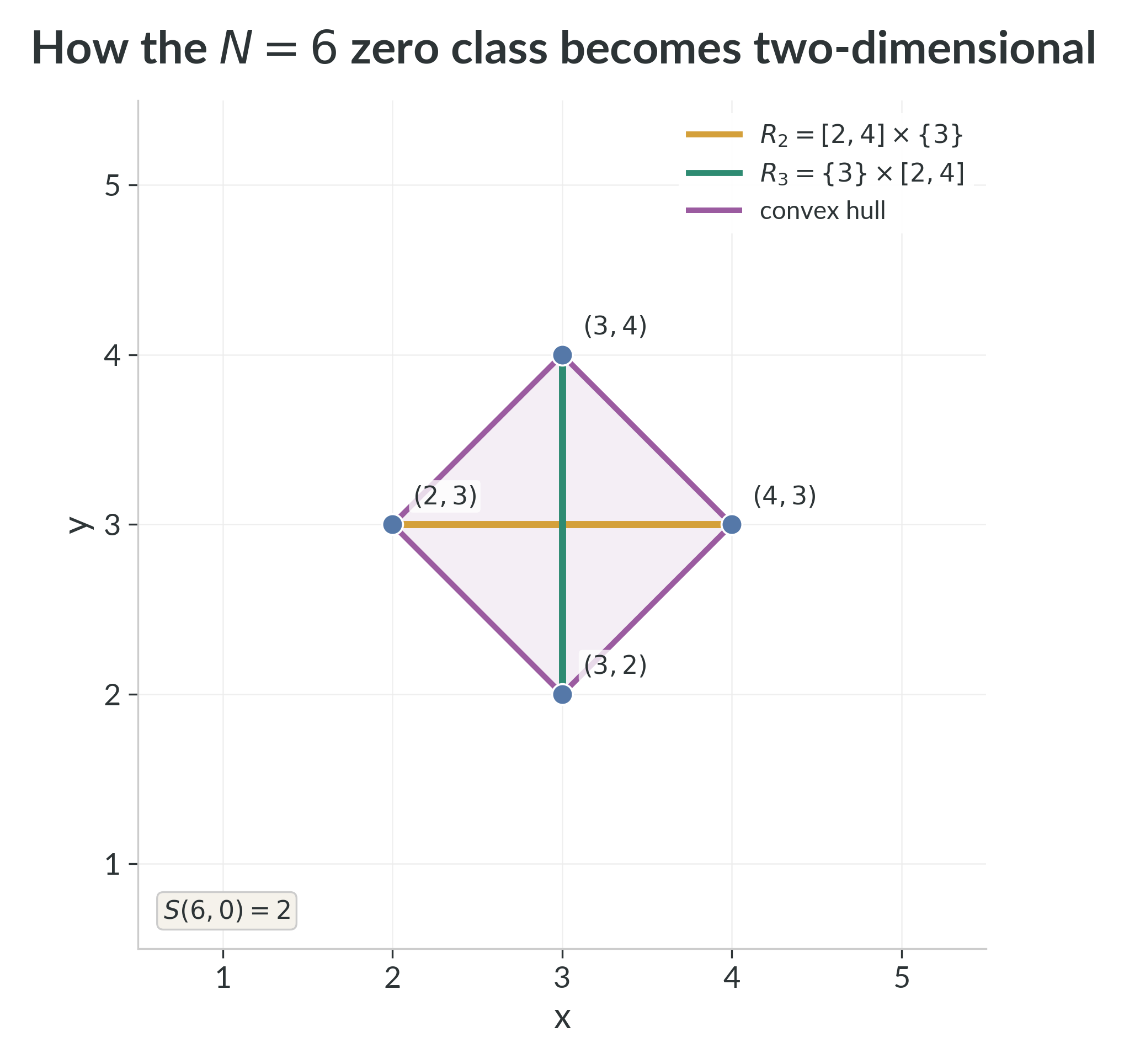
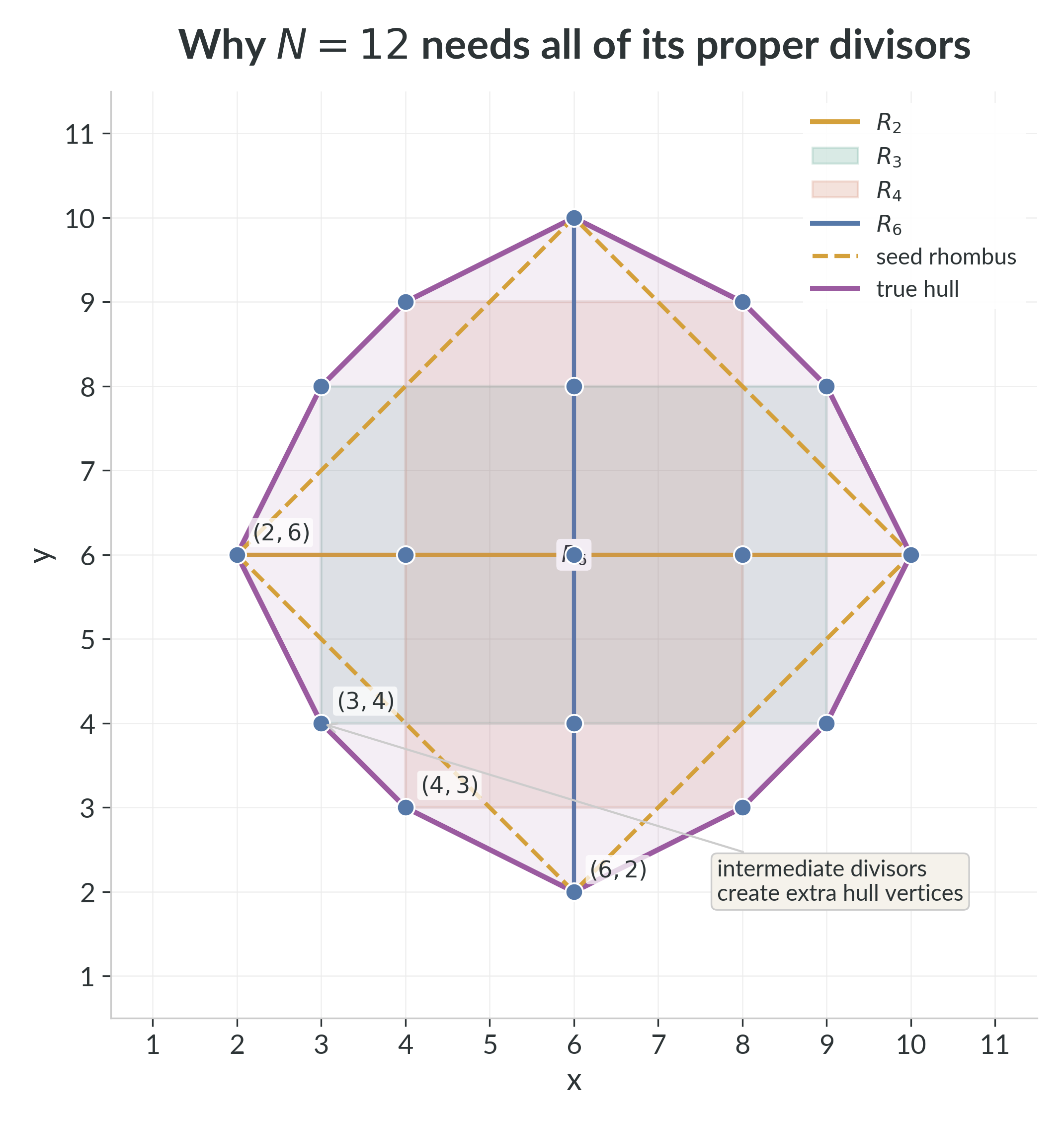
For each proper divisor $d$ of a composite modulus $N$, define the divisor rectangle $$ R_d := [d,\,N-d] \times \left[\frac{N}{d},\,N-\frac{N}{d}\right]. $$ If one interval collapses to a point, the rectangle degenerates to a segment; if both collapse, it degenerates to a single point.
For example, when $N=6$ the only proper divisors are $2$ and $3$, so $$ R_2 = [2,4] \times \{3\}, \qquad R_3 = \{3\} \times [2,4]. $$ Their convex hull is already the full zero-class hull. It is also useful to notice the direction of these degenerate rectangles: small divisors tend to produce wide, low horizontal objects, while the complementary divisors produce tall, narrow vertical ones. Transpose symmetry exchanges those two directions.
Step 3: exact hull theorem
So the discrete zero class, the union of divisor rectangles, and the hull are different geometric objects, but the last two have the same convex hull.
Step 4: divisor points and the lower edge of the hull
Let
$$
p := \min\{d>1 : d \mid N\}
$$
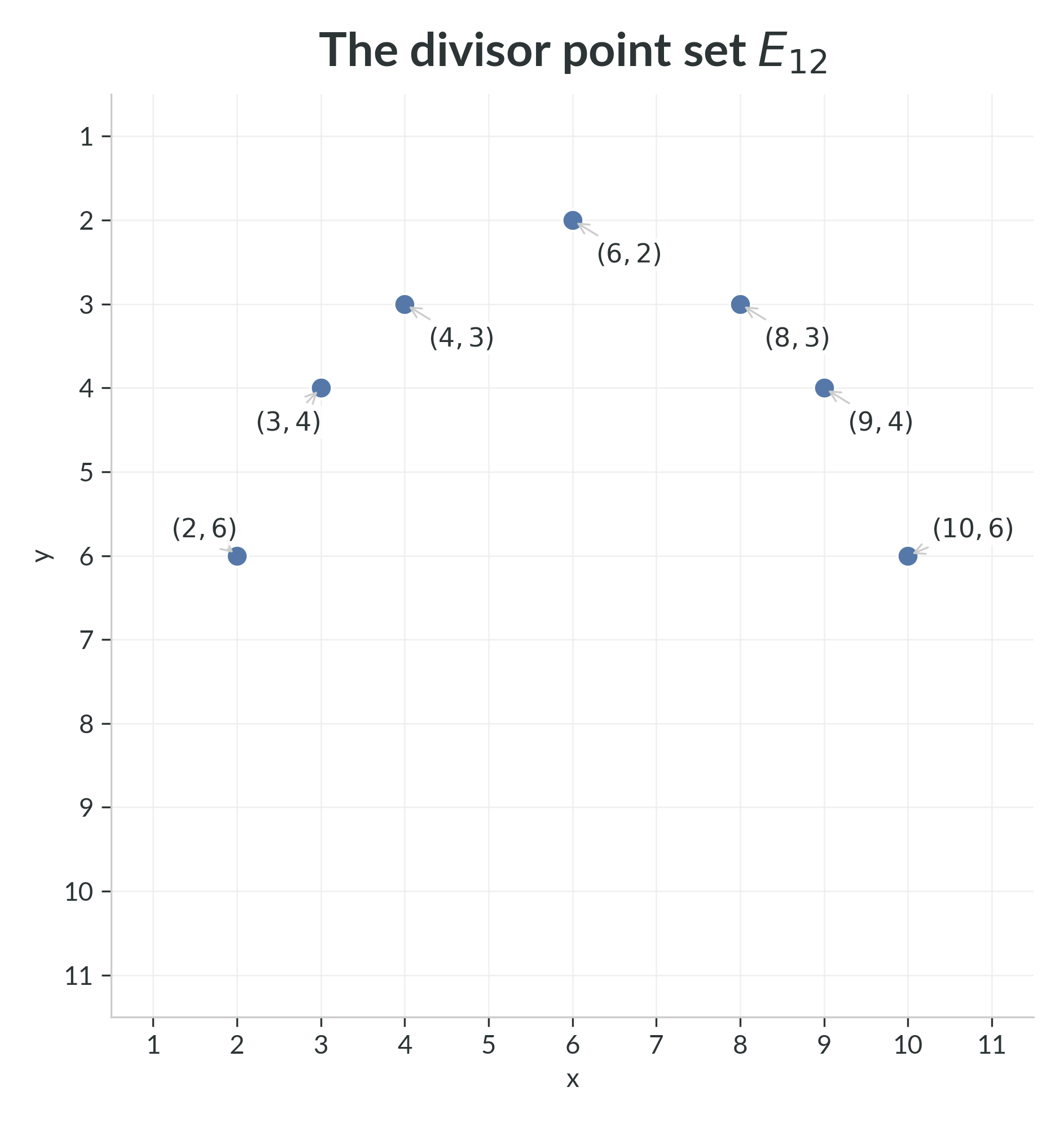
be the smallest proper divisor, and define the divisor point set
$$
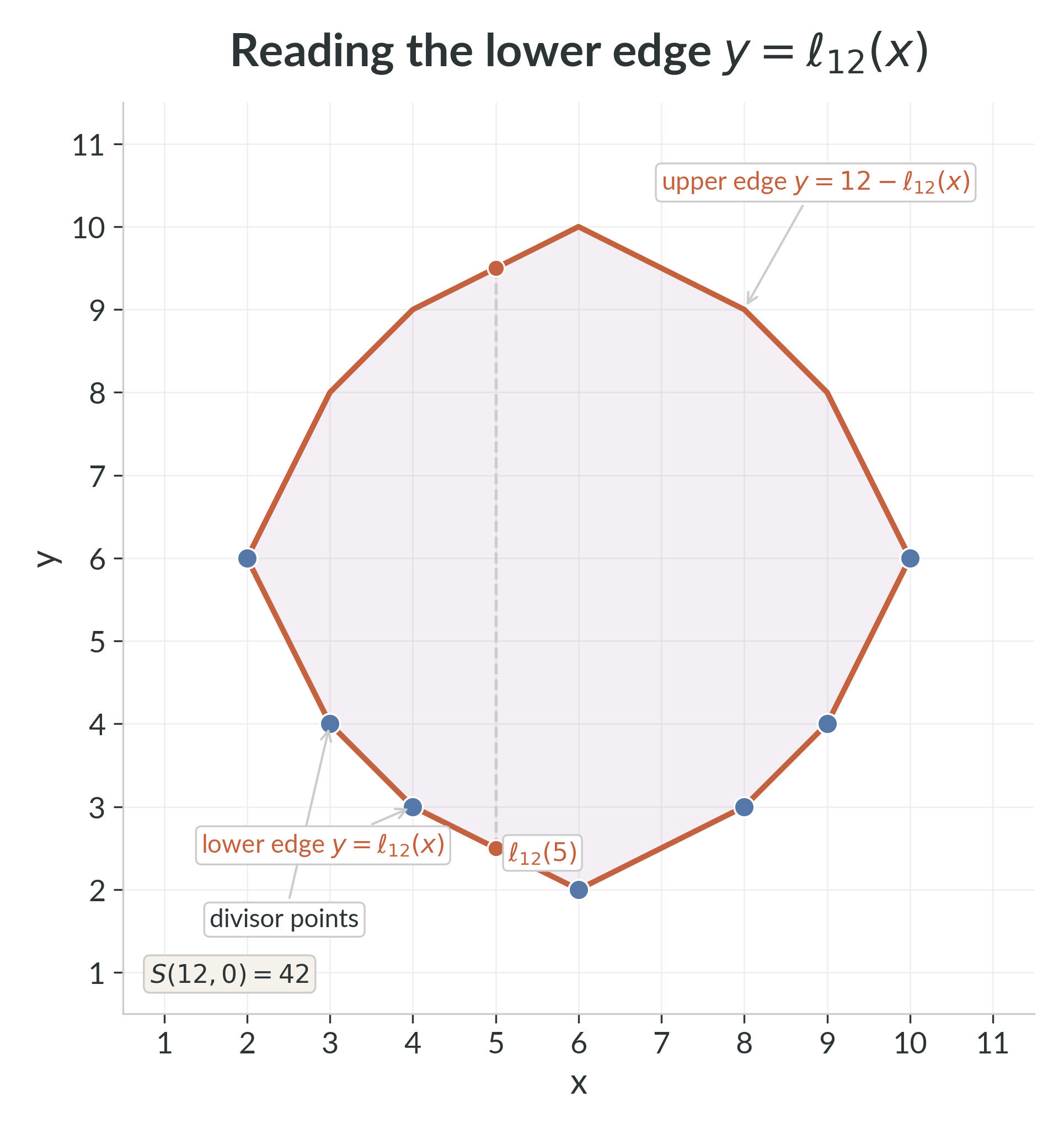
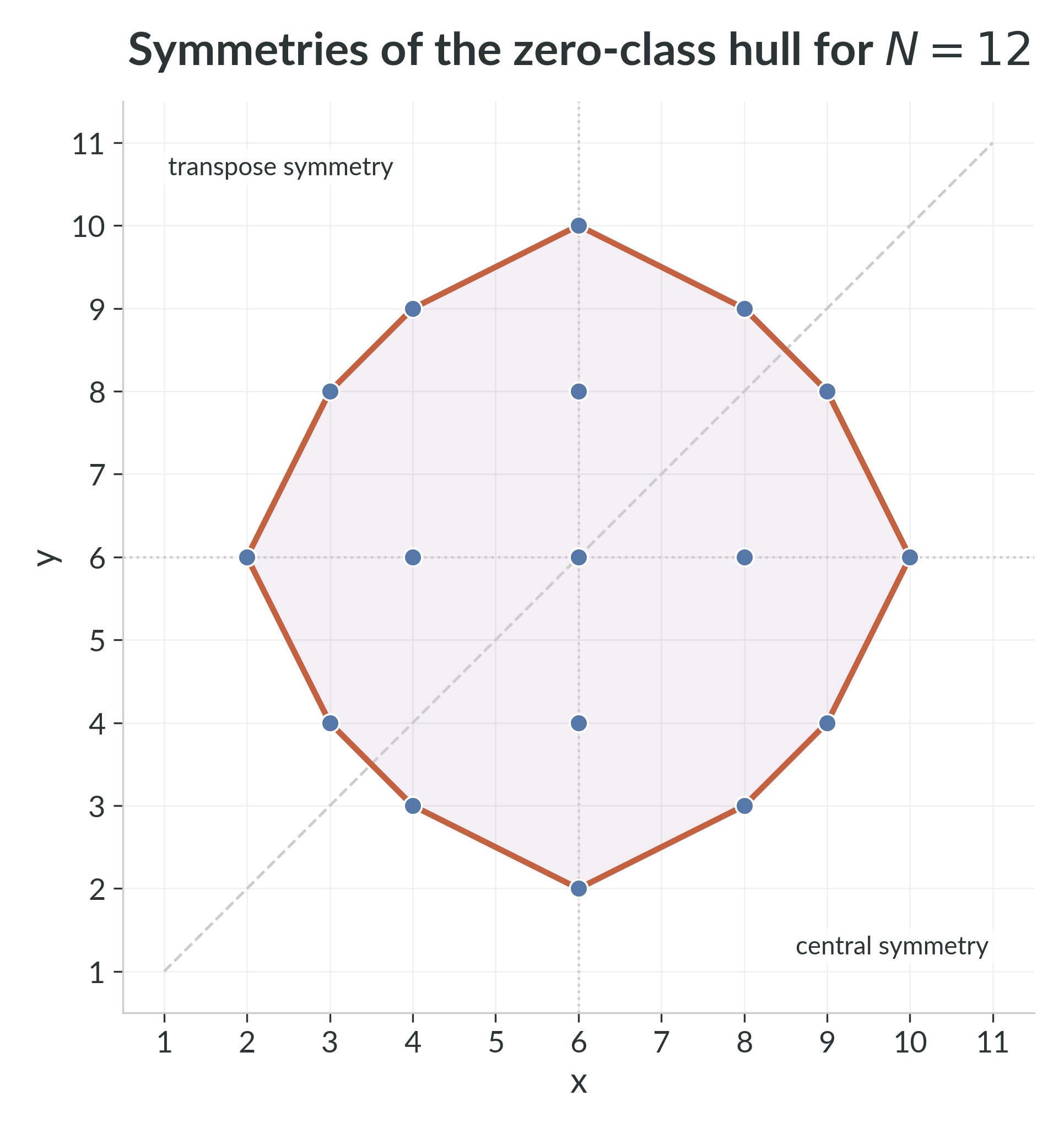
E_N := \left\{\left(d,\frac{N}{d}\right), \left(N-d,\frac{N}{d}\right) : 1 A broken line is just a connected chain of straight segments. The lower broken line through the lower edge of $\operatorname{conv}(E_N)$ controls the whole hull. Here the phrase "lower convex envelope" means exactly that lower boundary traced by the convex hull. For $p \le x \le N-p$, let $\ell_N(x)$ be the height of that lower broken line at horizontal position $x$. Then the whole zero-class hull is the region
$$
\operatorname{conv}(A_{N,0})
=
\{(x,y) : p \le x \le N-p,\ \ell_N(x) \le y \le N-\ell_N(x)\}.
$$
Transpose symmetry matches the left and right sides across $x=y$, and central symmetry reflects the lower edge to the upper edge. Once the lower edge is known, the area follows immediately:
$$
S(N,0)=\int_p^{N-p} \bigl(N-2\ell_N(x)\bigr)\,dx.
$$
If the lower-hull vertices of $\operatorname{conv}(E_N)$ are
$$
v_1=(x_1,y_1),\ldots,v_r=(x_r,y_r), \qquad x_1=p,\ x_r=N-p,
$$
listed from left to right, then the same area is given by the trapezoidal sum
$$
S(N,0)=\sum_{j=1}^{r-1}(x_{j+1}-x_j)\bigl(N-y_j-y_{j+1}\bigr).
$$
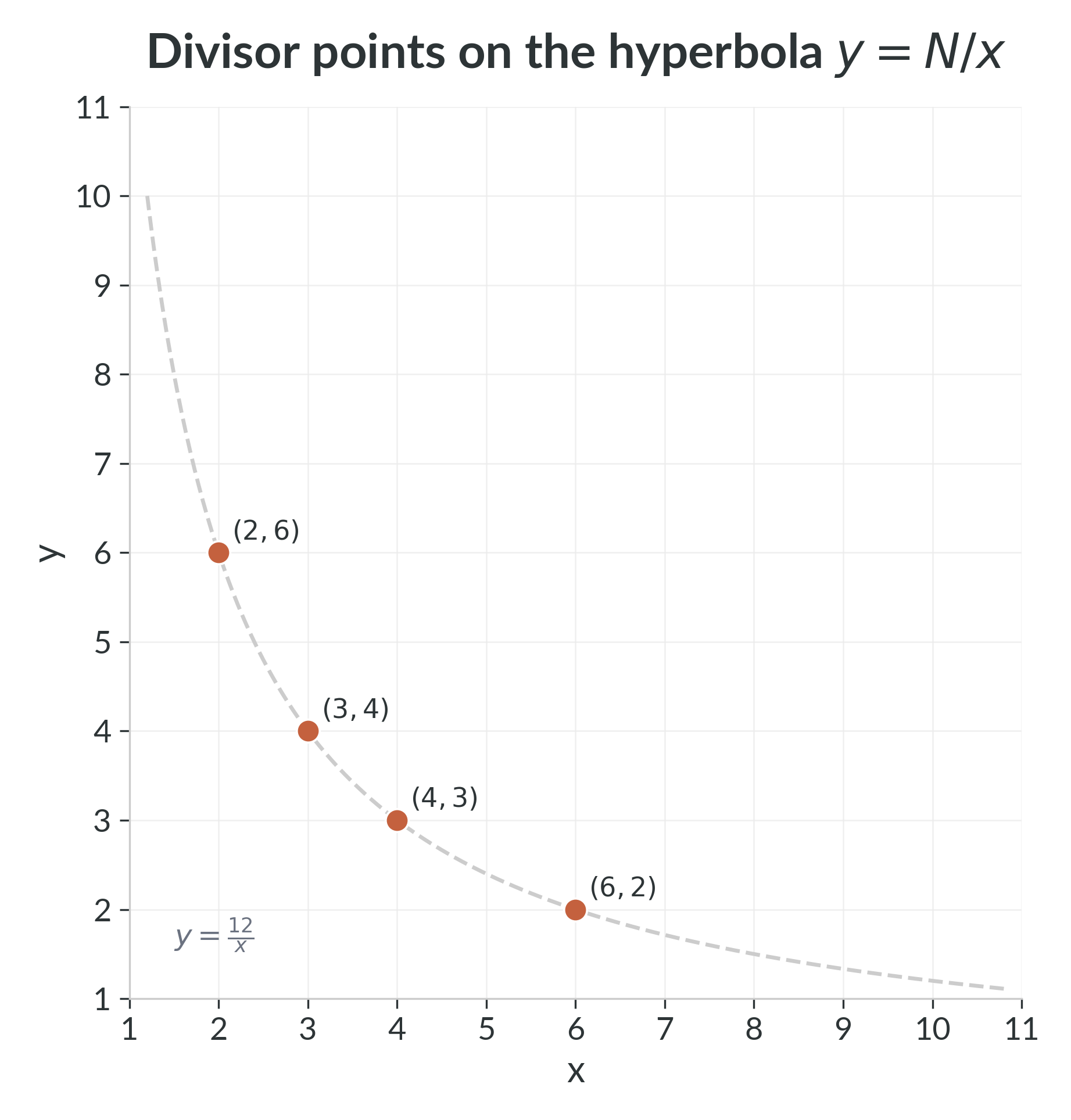
So the zero-class area is no longer mysterious once the divisor geometry is known. The same divisor points also lie on the continuous hyperbola
$$
y=\frac{N}{x}.
$$
The lower hull is not that curve itself; it is the polygonal envelope through sampled divisor points. This leads to the nonnegative hyperbola-gap correction
$$
\Delta_N:=\int_p^{N/2}\left(\ell_N(x)-\frac{N}{x}\right)\,dx,
$$
and to the exact decomposition
$$
S(N,0)=N(N-2p)-4N\ln\left(\frac{N}{2p}\right)-4\Delta_N.
$$
So the zero-class area can be read as a smooth hyperbolic baseline minus an arithmetic polygonal correction. The full segment formula and the worked case $N=12$ are collected in zero_class_hyperbola_gap.Step 5: exact area formulas
Step 6: compare the polygon with the hyperbola
Figures
Related Concepts
- A_N_a — the zero residue class itself
- zero_class_hyperbola_gap — exact gap between the divisor envelope and the hyperbola
- S_N_a — area function whose zero-class term is solved here
- small_examples_atlas — the first small moduli where the zero class becomes visible
Tags
#definition #theorem #formula