First Boundary Model $S^{(1)}$
Definition
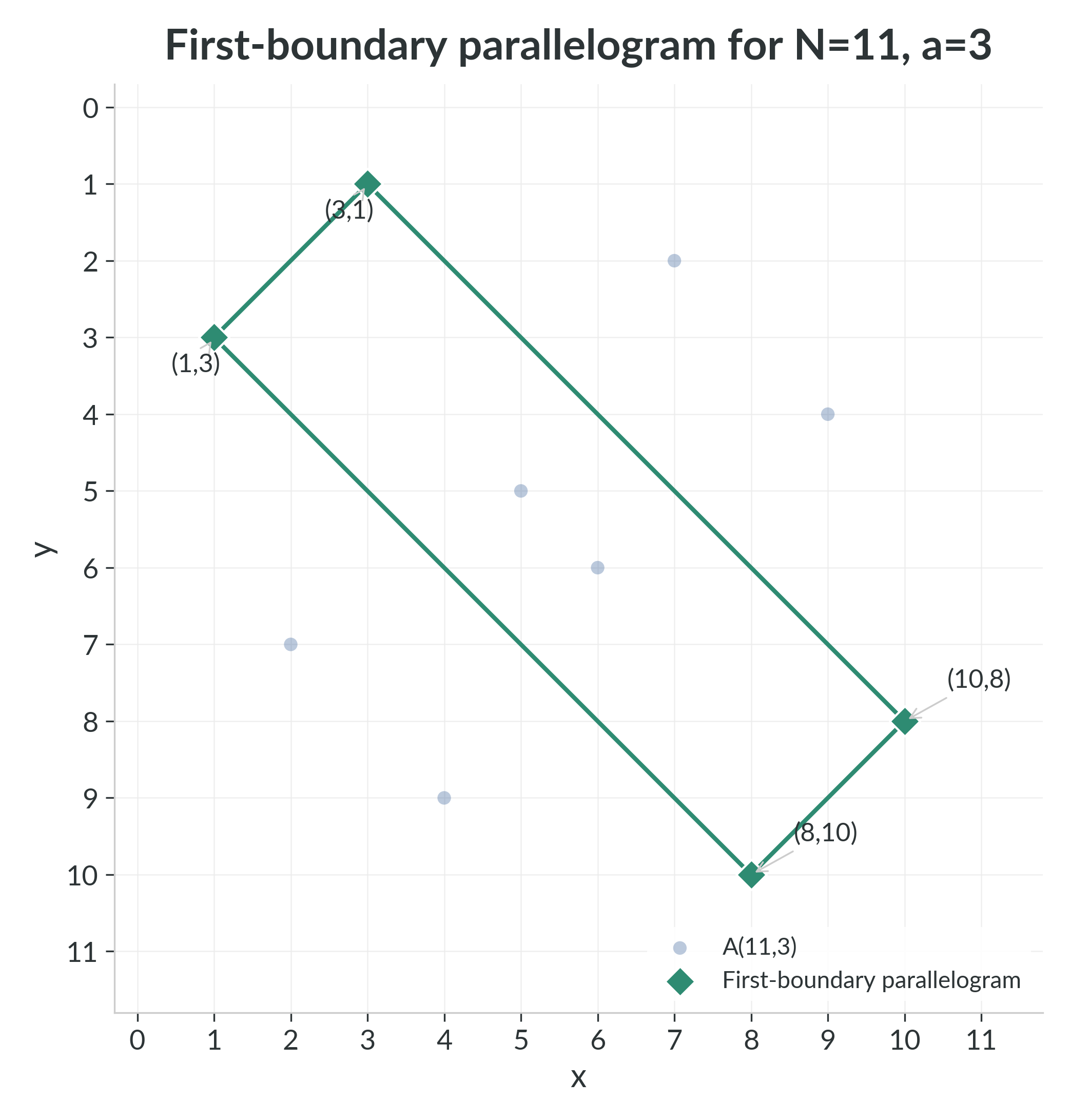
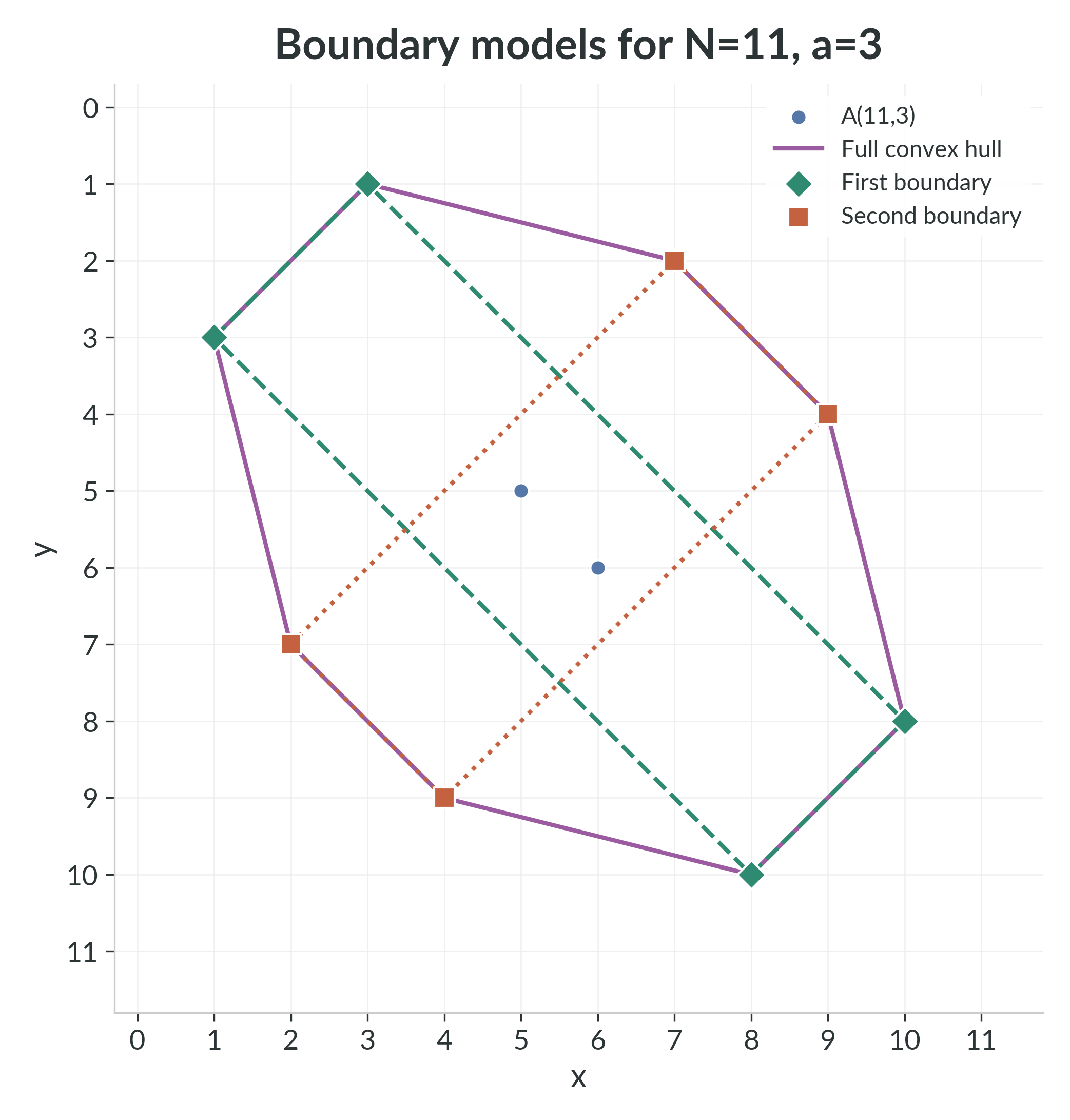
The first boundary, or outer frame, of MTMN uses rows and columns $1$ and $N-1$: $$ B^{(1)}_{N,a} := A_{N,a} \cap \bigl((\{1,N-1\}\times\{1,\ldots,N-1\}) \cup (\{1,\ldots,N-1\}\times\{1,N-1\})\bigr). $$ Set $$ S^{(1)}(N,a) := \operatorname{Area}(\operatorname{conv}(B^{(1)}_{N,a})), \qquad S^{(1)}(N) := \sum_{a=0}^{N-1} S^{(1)}(N,a). $$ By construction, $$ B^{(1)}_{N,a} \subseteq A_{N,a}, \qquad S^{(1)}(N,a) \leq S(N,a), \qquad S^{(1)}(N) \leq S(N). $$ So this is an exact lower-bound model rather than a heuristic approximation.
Exact per-residue formula
The corresponding hull is the parallelogram with vertices $$ (1,a),\quad (a,1),\quad (N-1,N-a),\quad (N-a,N-1). $$ When $a=1$ or $a=N-1$, that parallelogram degenerates and the area is $0$.
Exact total formula
Exact reciprocal constants
These exact constants show that the first boundary is not only a local geometric model. It also controls the reciprocal and weighted comparison series for the full-MTMN totals.
Figures
Related Concepts
- S_N_a — the full per-residue area function being approximated
- S_N — total area sum being approximated
- second_boundary_model — next exact layer
Tags
#definition #theorem #formula