Main Results
This page collects the current theorem-bearing results in the project. It is the shortest route to the exact statements that are already established.
1. Exact Area Data Exists Residue By Residue
The basic objects are the residue classes A_N_a, their convex-hull areas S_N_a, and the total S_N.
Already proved:
- every $S(N,a)$ is a nonnegative integer
- therefore every $S(N)$ is a nonnegative integer
- the full family of areas is symmetric under complementary residues
Best entry points:
2. The Zero Class Is Solved Geometrically
The zero residue is the strongest current theorem package.
- Degeneracy criterion: $$ S(N,0)=0 \iff N \text{ is prime or } N=4. $$
- Exact hull theorem for composite $N$:
$$
\operatorname{conv}(A_{N,0})
=
\operatorname{conv}\!\left(
\bigcup_{\substack{d\mid N\\1
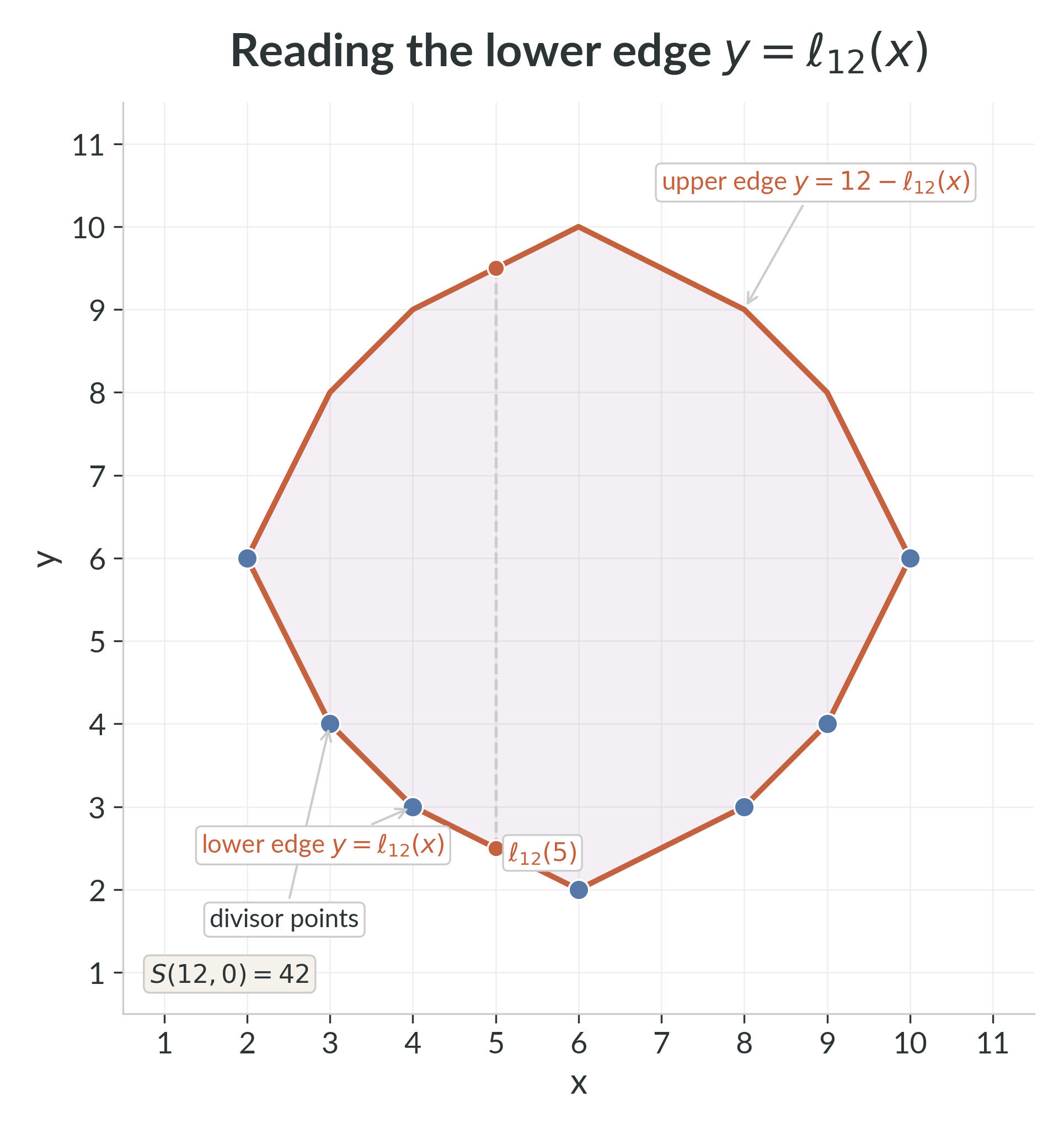
- Lower-envelope description: the whole hull is the region between the broken line $y=\ell_N(x)$ and its centrally symmetric reflection.
- Exact area formulas: both the integral formula and the trapezoidal formula are explicit once the divisor-envelope geometry is known.
Best entry points:
3. The Zero-Class Area Has An Exact Hyperbolic Decomposition
The divisor points lie on the sampled hyperbola $$ y = \frac{N}{x}, $$ but the true lower hull is polygonal. The nonnegative gap term $$ \Delta_N := \int_p^{N/2}\left(\ell_N(x)-\frac{N}{x}\right)\,dx $$ measures the exact difference between the arithmetic polygon and the smooth hyperbolic baseline.
The resulting identity is $$ S(N,0)=N(N-2p)-4N\ln\left(\frac{N}{2p}\right)-4\Delta_N. $$
This is not a heuristic asymptotic. It is an exact decomposition of the solved zero-class area.
Best entry points:
4. The First Boundary Gives An Exact Global Lower Model
The first boundary model keeps only rows and columns $1$ and $N-1$.
Its exact residue formula is $$ S^{(1)}(N,a)=2(a-1)(N-a-1) \qquad (1 \le a \le N-1), $$ with $S^{(1)}(N,0)=0$, and its exact total is $$ S^{(1)}(N)=\frac{(N-3)(N-2)(N-1)}{3}. $$
This gives a completely explicit residue-wise lower model for the full area data.
Best entry points:
5. The Total Area Has Rigorous Cubic Order
Combining the exact first-boundary lower model with the trivial square-window upper bound gives $$ \frac{(N-3)(N-2)(N-1)}{3} \le S(N) \le N(N-2)^2. $$
So the total area already has the proved growth law $$ S(N)=\Theta(N^3). $$
This is the main global theorem currently available for the full residue family.
Best entry points:
6. Strong Supporting Result: The Odd-$N$ Second Boundary
For odd $N$, the second boundary model is also explicit: $$ S^{(2)}(N,a)=2|b-2||N-b-2|, \qquad b\equiv 2^{-1}a \pmod N. $$
This is a genuine extension of the boundary program, but it plays a supporting role relative to the zero-class package and the first-boundary global theorem.
Best entry point:
Recommended Reading Order
If you want the strongest short route, read in this order:
- compact_note
- zero_class_geometry
- zero_class_hyperbola_gap
- first_boundary_model
- Full monograph if you want the broader package