Convex Hull Area Function $S(N,a)$
Definition
$$ S(N,a) = \operatorname{Area}(\operatorname{conv}(A_{N,a})). $$ This is the main per-residue geometric quantity of MTMN. It sits after the discrete set A_N_a and before the total sum S_N.
Structural facts already proved
The integrality statement comes from central symmetry together with Pick's theorem.
Exact support-function formula
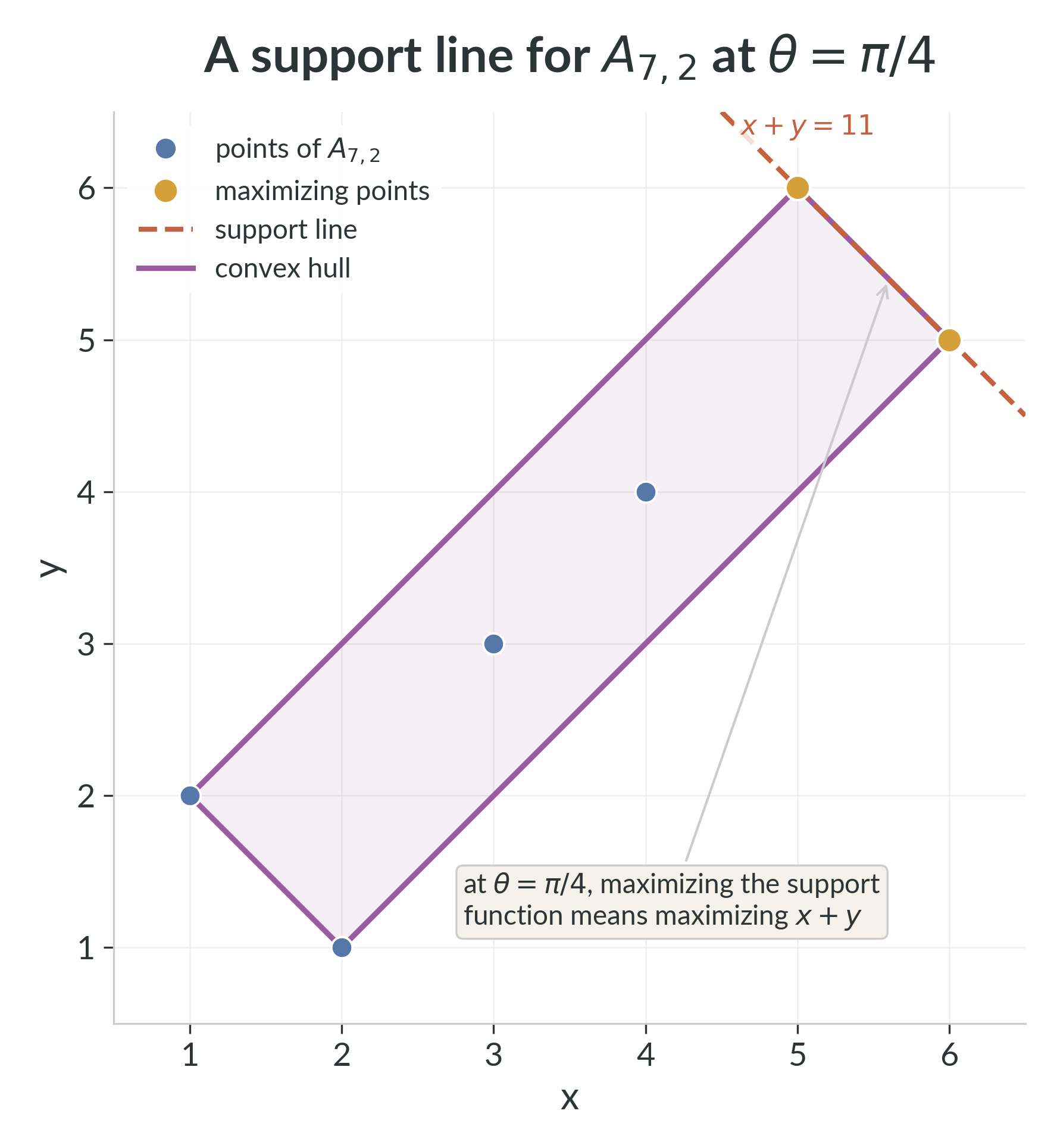
The exact area can be encoded by the support function $$ h_{N,a}(\theta) := \max_{(x,y)\in A_{N,a}} (x\cos\theta + y\sin\theta), $$ through the identity $$ S(N,a) = \frac{1}{2}\int_0^{2\pi} \bigl(h_{N,a}(\theta)^2 - h_{N,a}'(\theta)^2\bigr)\,d\theta. $$ This is exact, but it does not by itself solve the problem: one still has to understand which lattice point wins in each direction.
Exponential reformulation
The same support function admits an exact exponential package. Set $$ F_{N,a}(\theta,\lambda) := \sum_{(x,y)\in A_{N,a}} e^{\lambda(x\cos\theta + y\sin\theta)}. $$ Then $$ h_{N,a}(\theta) = \lim_{\lambda \to \infty} \frac{1}{\lambda}\log F_{N,a}(\theta,\lambda). $$ This is the MTMN-specific exponential reformulation of the same convex-geometric data.
Boundary models
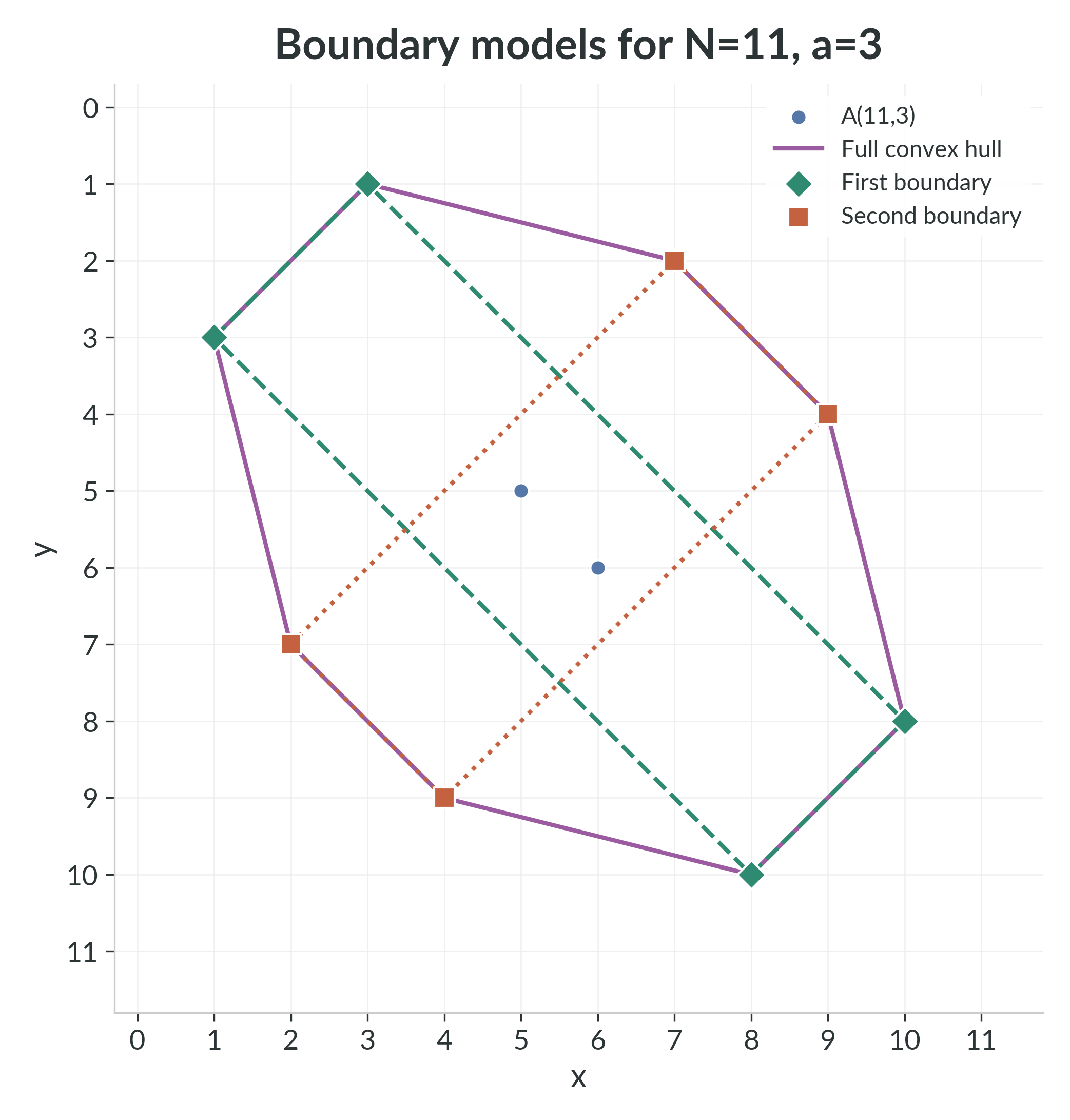
The current exact lower models are
- first_boundary_model, with $$S^{(1)}(N,a)=2(a-1)(N-a-1)$$ for $1 \le a \le N-1$
- second_boundary_model, with the exact odd-$N$ formula $$S^{(2)}(N,a)=2|b-2||N-b-2|, \qquad b\equiv 2^{-1}a \pmod N$$
Solved special residue: the zero class
The zero residue now has a complete geometric description in zero_class_geometry. In particular, $$ S(N,0)=0 \iff N \text{ is prime or } N=4. $$ So the remaining general difficulty is not the existence of exact structure in special cases, but the lack of a full arithmetic description of all hull vertices and support winners.
Figures
Related Concepts
- A_N_a — the underlying lattice set
- S_N — total sum over residues
- first_boundary_model — exact first boundary approximation
- second_boundary_model — exact odd-$N$ second boundary approximation
- zero_class_geometry — complete solution for the zero residue
Tags
#definition #formula #theorem