Second Boundary Model $S^{(2)}$
Definition
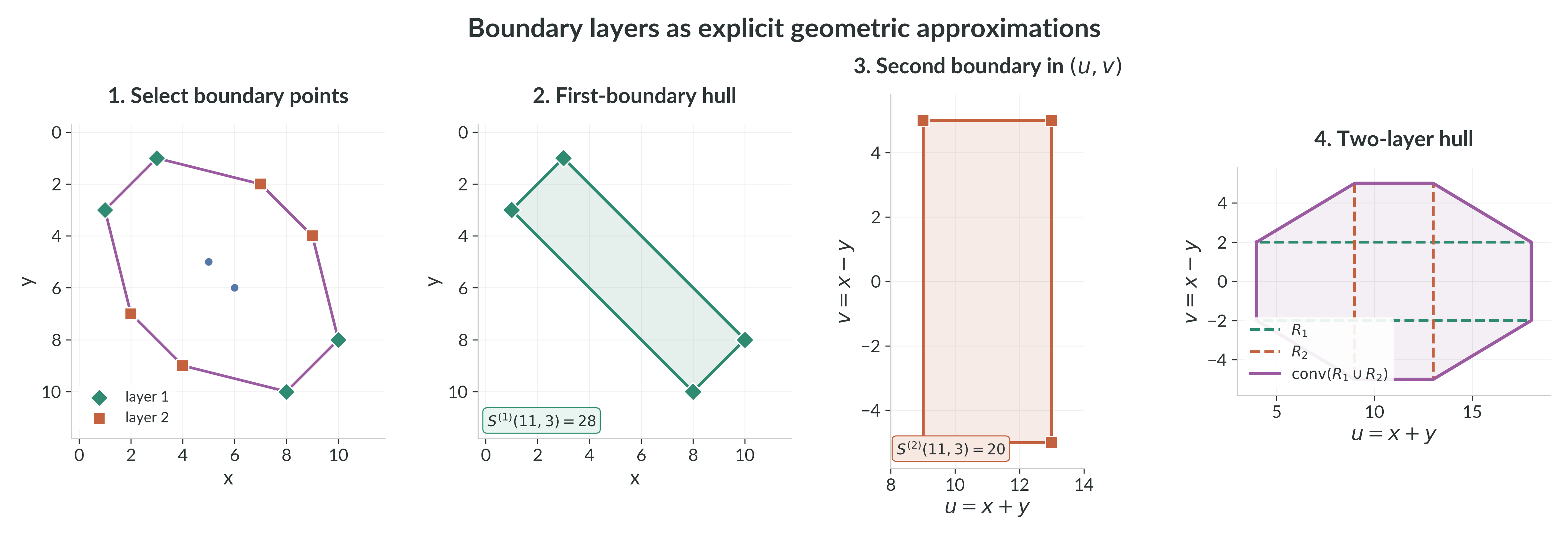
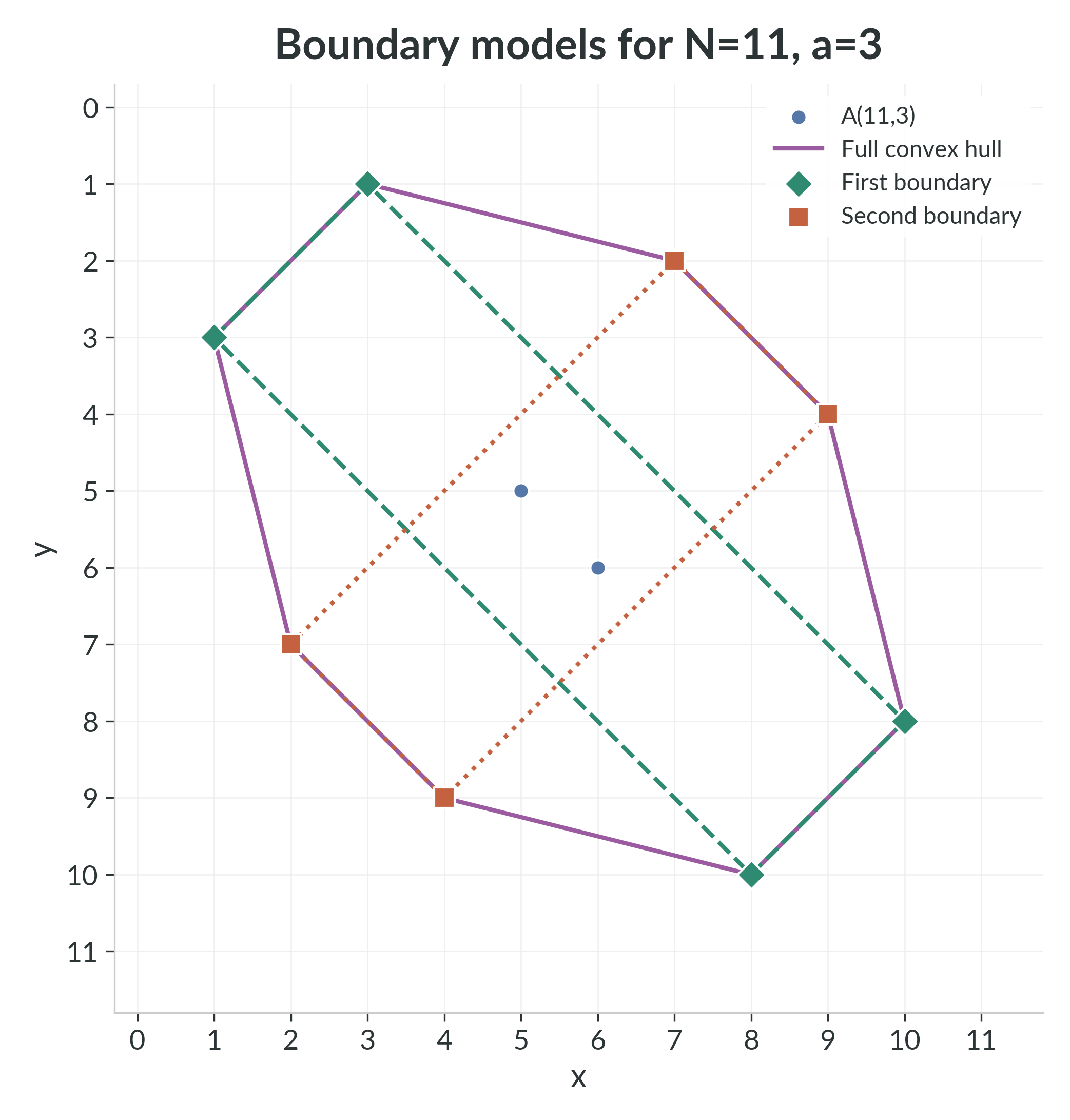
The second boundary uses rows and columns $2$ and $N-2$: $$ B^{(2)}_{N,a} := A_{N,a} \cap \bigl((\{2,N-2\}\times\{1,\ldots,N-1\}) \cup (\{1,\ldots,N-1\}\times\{2,N-2\})\bigr). $$ Set $$ S^{(2)}(N,a) := \operatorname{Area}(\operatorname{conv}(B^{(2)}_{N,a})), \qquad S^{(2)}(N) := \sum_{a=0}^{N-1} S^{(2)}(N,a). $$ Again one has the lower bounds $$ S^{(2)}(N,a) \le S(N,a), \qquad S^{(2)}(N) \le S(N). $$
Exact odd-$N$ formula
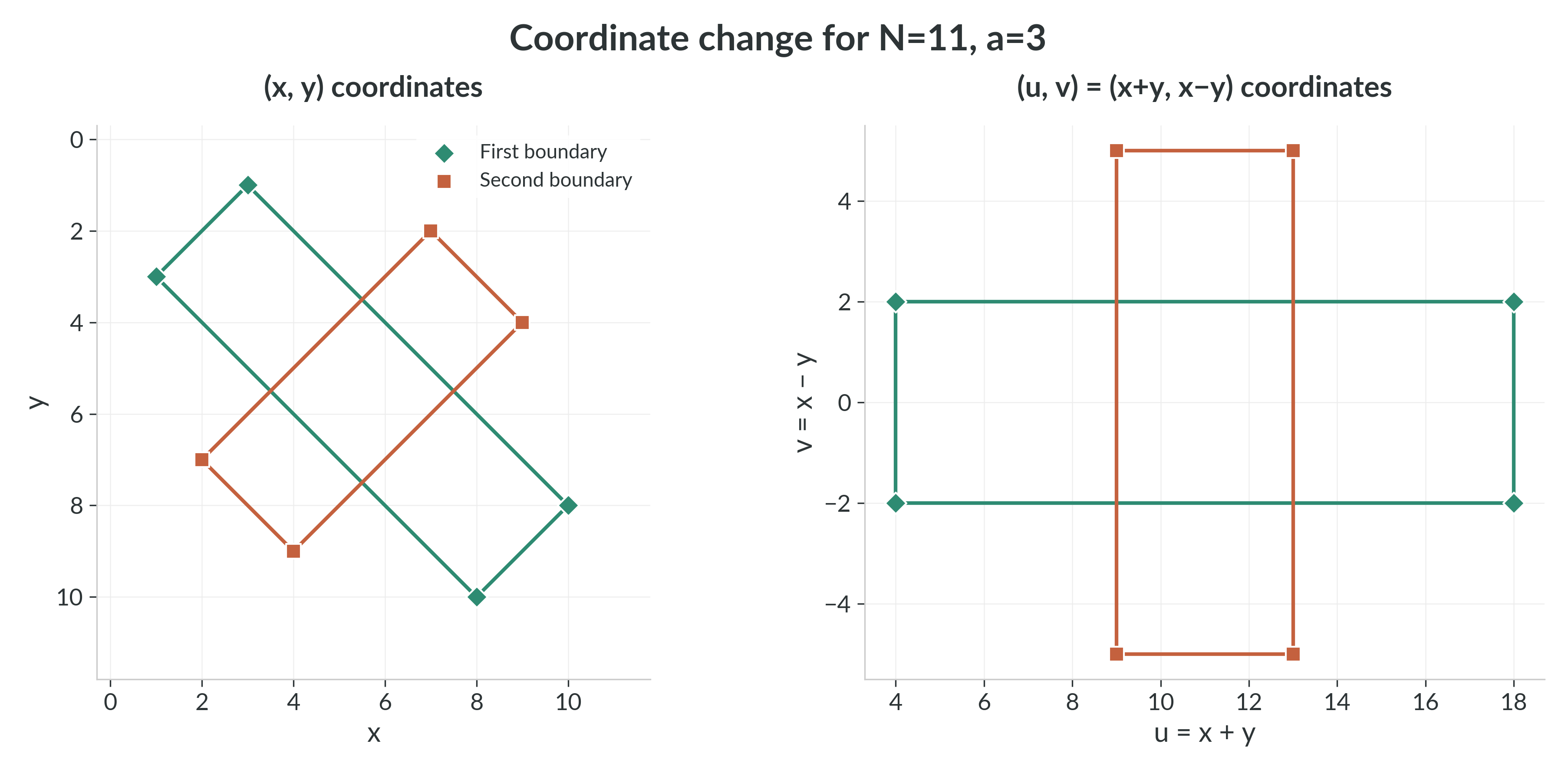
When $N$ is odd, $2$ is invertible modulo $N$. Let $$ b \equiv 2^{-1}a \pmod N. $$ Then the second boundary points are $$ (2,b),\quad (b,2),\quad (N-2,N-b),\quad (N-b,N-2), $$ and one gets the exact area formula $$ S^{(2)}(N,a)=2|b-2||N-b-2|, $$ with $$ S^{(2)}(N,0)=0. $$ Passing to $$ u=x+y, \qquad v=x-y $$ turns these four points into an axis-aligned rectangle, which is why the formula is so clean.
Exact odd-$N$ total
For odd $N$, $$ S^{(2)}(N) = \frac{(N-3)(N^2-9N+32)}{3}. $$ So the second boundary is the next exact cubic layer in the boundary program.
Even $N$
When $N$ is even, $2$ is no longer invertible modulo $N$, so the clean one-parameter description breaks. Some residues contribute no second-boundary points at all, while others hit a side more than once. This is the first genuinely different local obstruction in the boundary program.
Figures
Related Concepts
- S_N_a — full per-residue area function
- S_N — total area sum
- first_boundary_model — exact outer-layer model
Tags
#definition #theorem #formula