Small Examples Atlas
Why this page exists
The first worked moduli should be read as complete mini-cases: raw table first, then the residue classes, then the hull overlay, and only after that the area values. This is the most concrete bridge from the elementary arithmetic definition of MTMN to the geometric quantities S_N_a and S_N.
The case $N=5$
Since $5$ is prime, every nonzero index is coprime to $5$, so this is the cleanest first example.
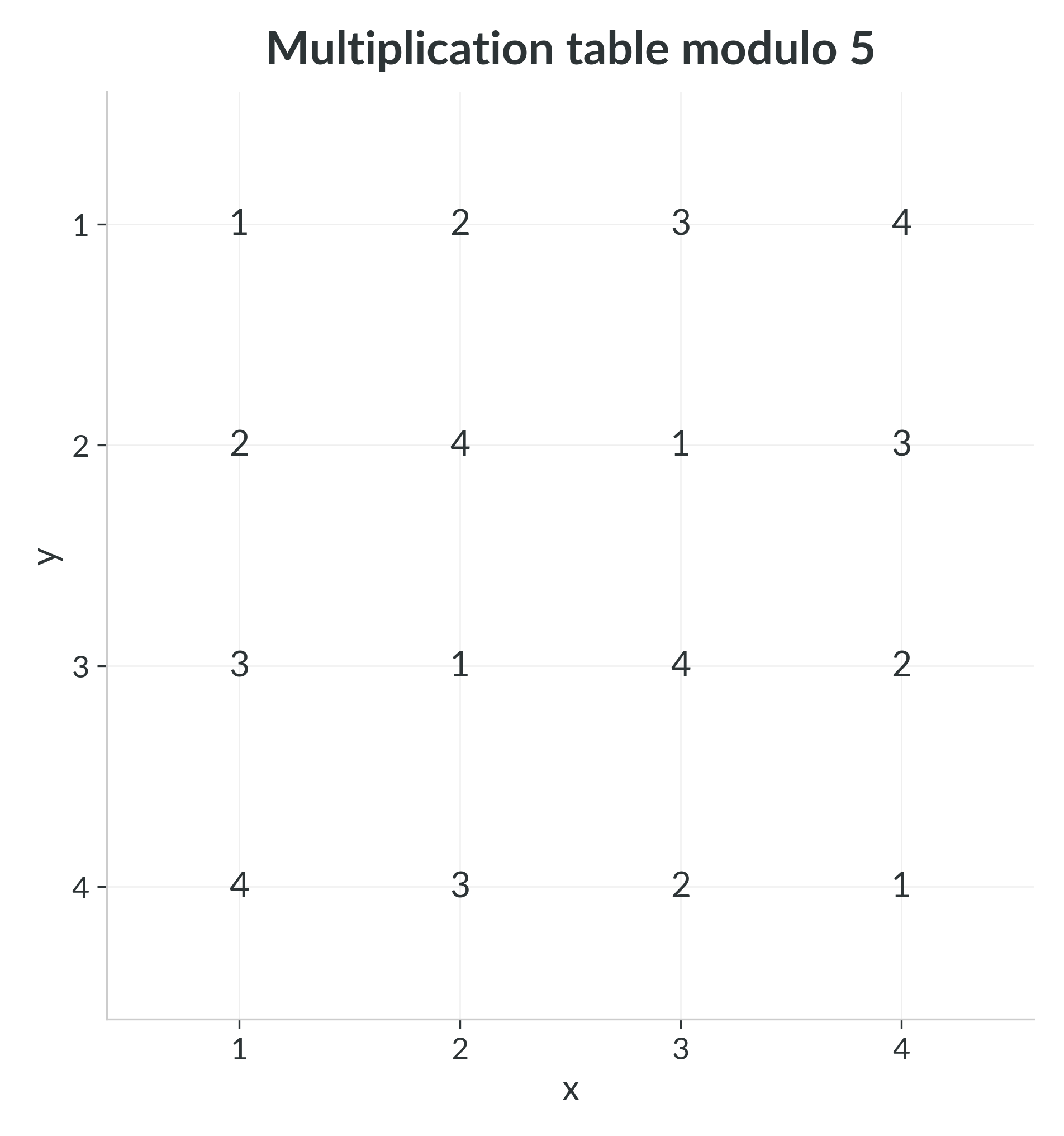
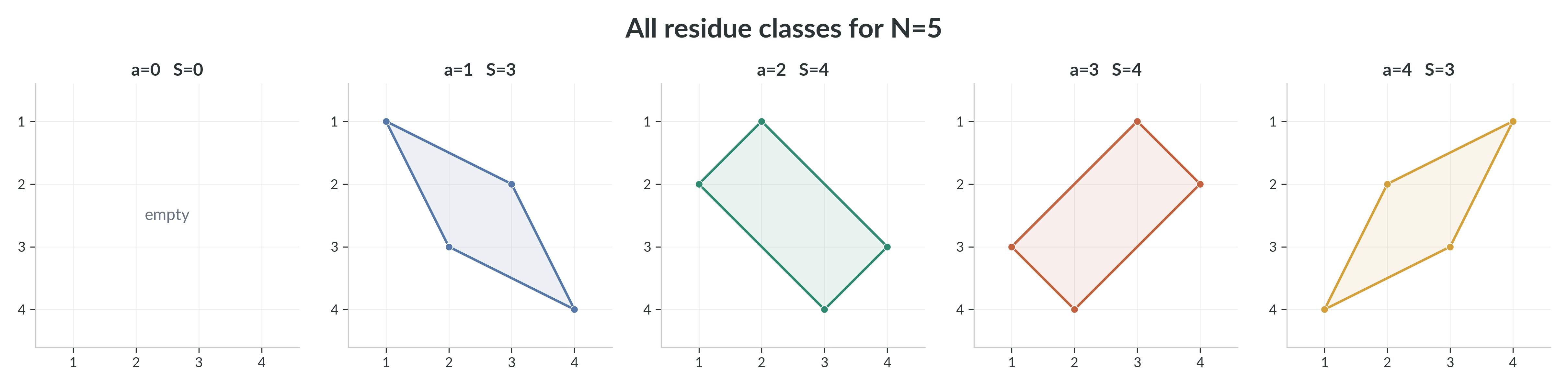
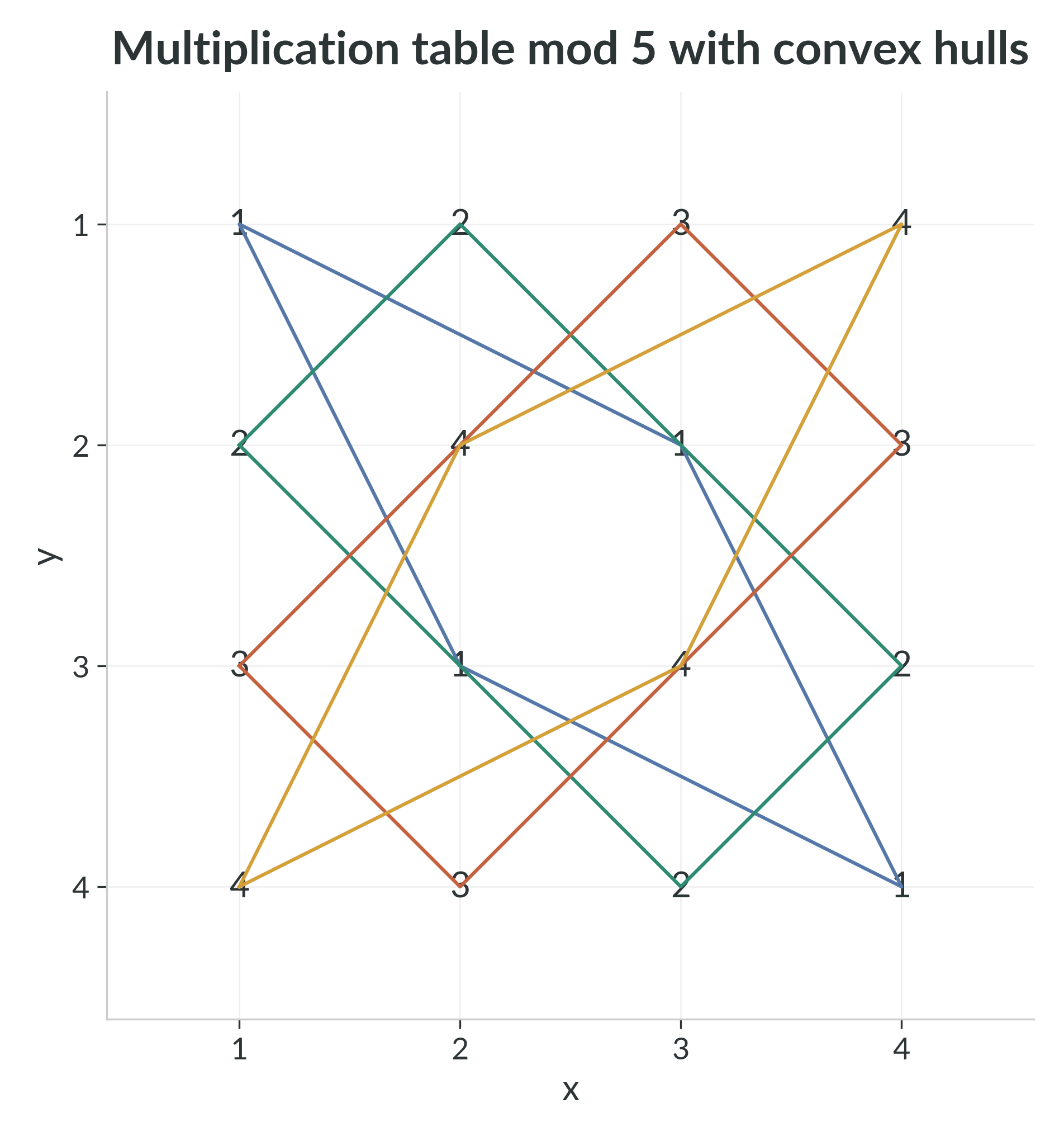
The exact values are $$ (S(5,0),S(5,1),S(5,2),S(5,3),S(5,4)) = (0,3,4,4,3), $$ so $$ S(5)=14. $$
The case $N=6$
The first even composite case already shows the new zero-divisor side.
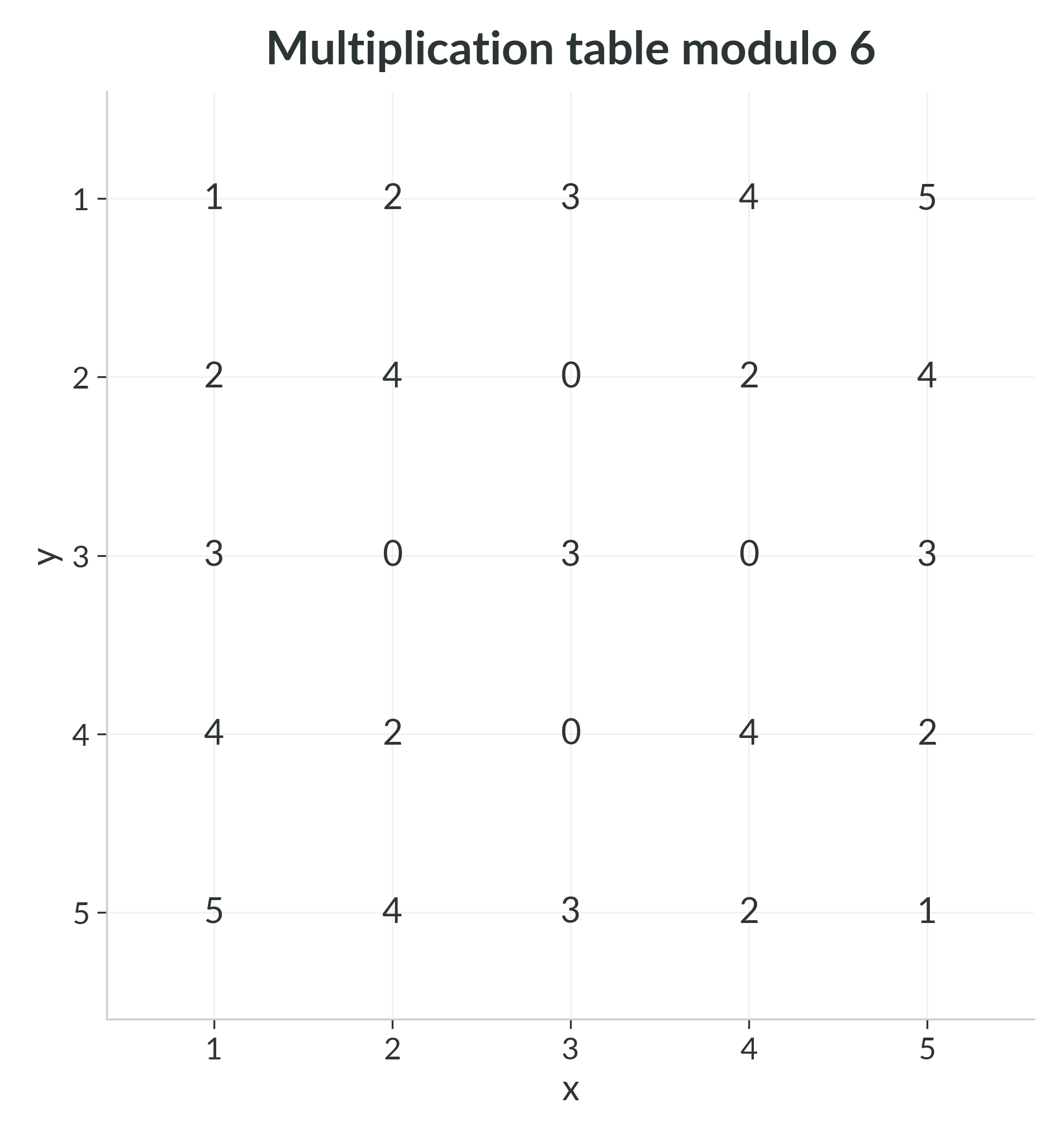
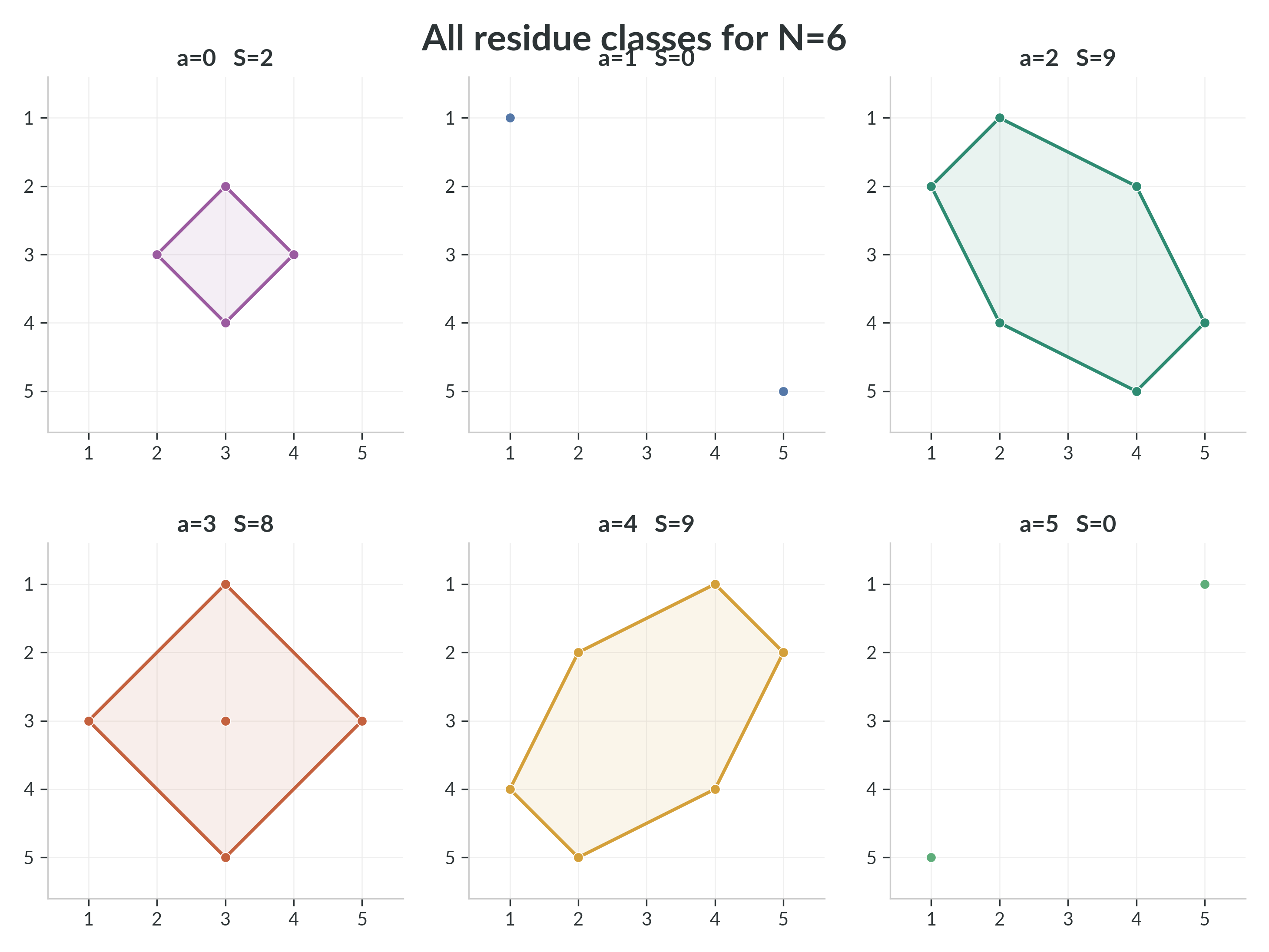
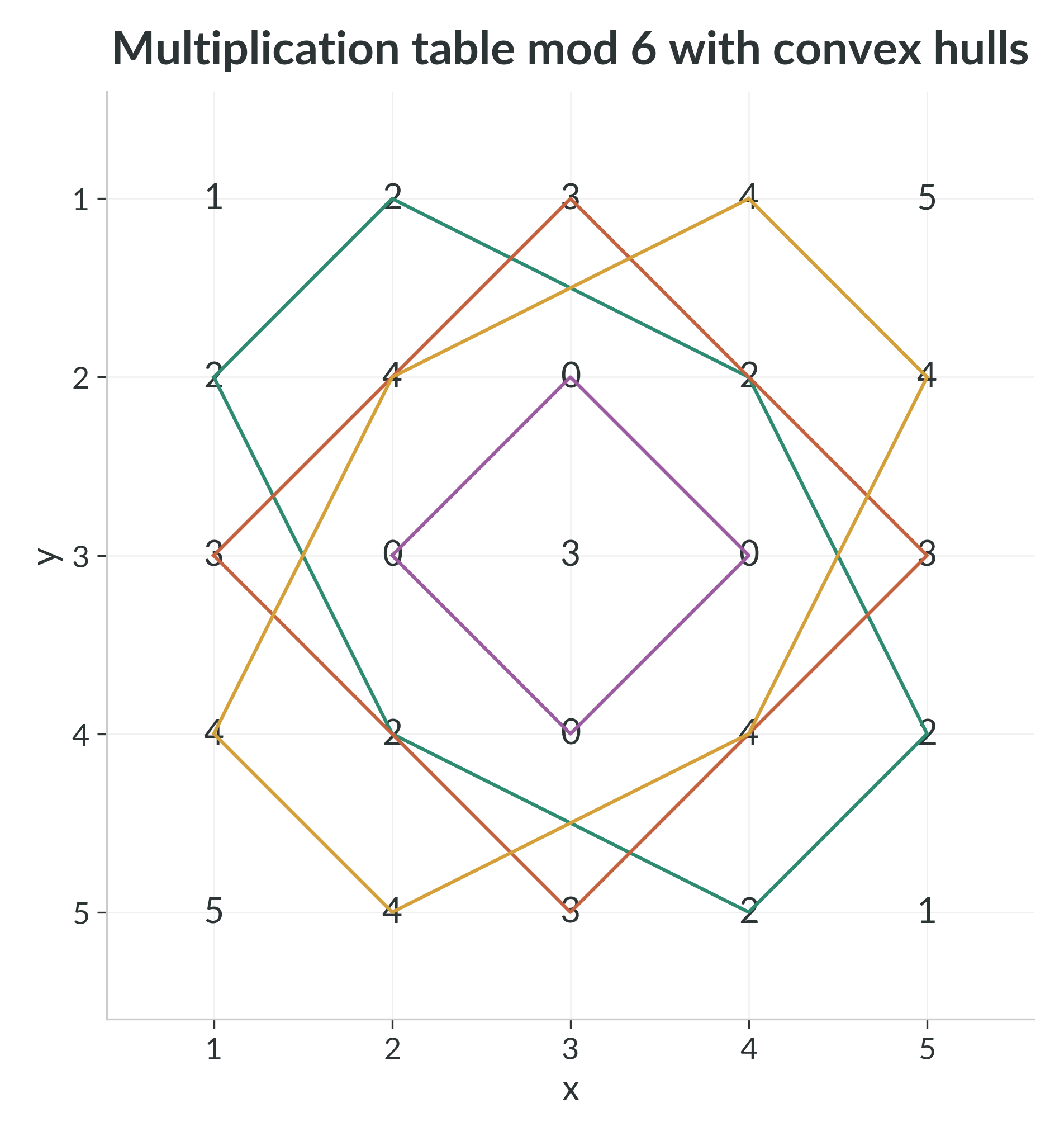
The exact values are $$ (S(6,0),S(6,1),S(6,2),S(6,3),S(6,4),S(6,5)) = (2,0,9,8,9,0), $$ so $$ S(6)=28. $$
What the atlas teaches early
- prime moduli show the clean permutation-plot regime on the nonzero grid
- composite moduli introduce a visible zero class and zero-divisor geometry
- the convex-hull areas are already nontrivial integers in very small examples
- these pages prepare the later exact stories for first_boundary_model and zero_class_geometry
Related Concepts
- MTMN — the main object illustrated here
- A_N_a — residue classes displayed panel by panel
- S_N_a — per-residue areas listed in the examples
- S_N — total area sums
- zero_class_geometry — the composite-side picture visible at $N=6$
Tags
#definition