Multiplication Table Modulo N (MTMN)
Definition
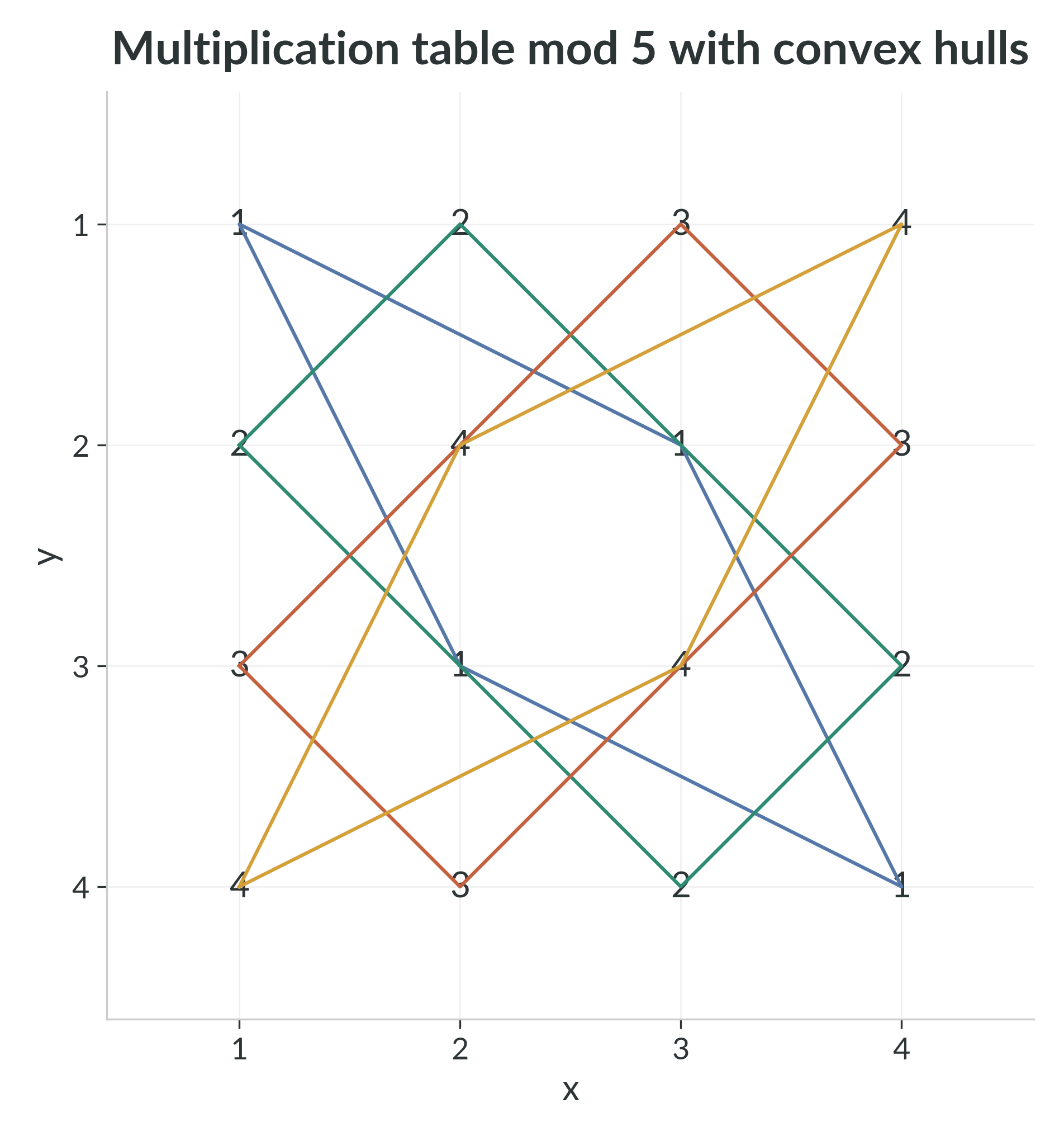
For a fixed integer $N \geq 2$, the multiplication table modulo $N$ is the array whose $(x,y)$-entry is $$ xy \bmod N, \qquad 1 \leq x,y \leq N-1. $$ We abbreviate this object by MTMN.
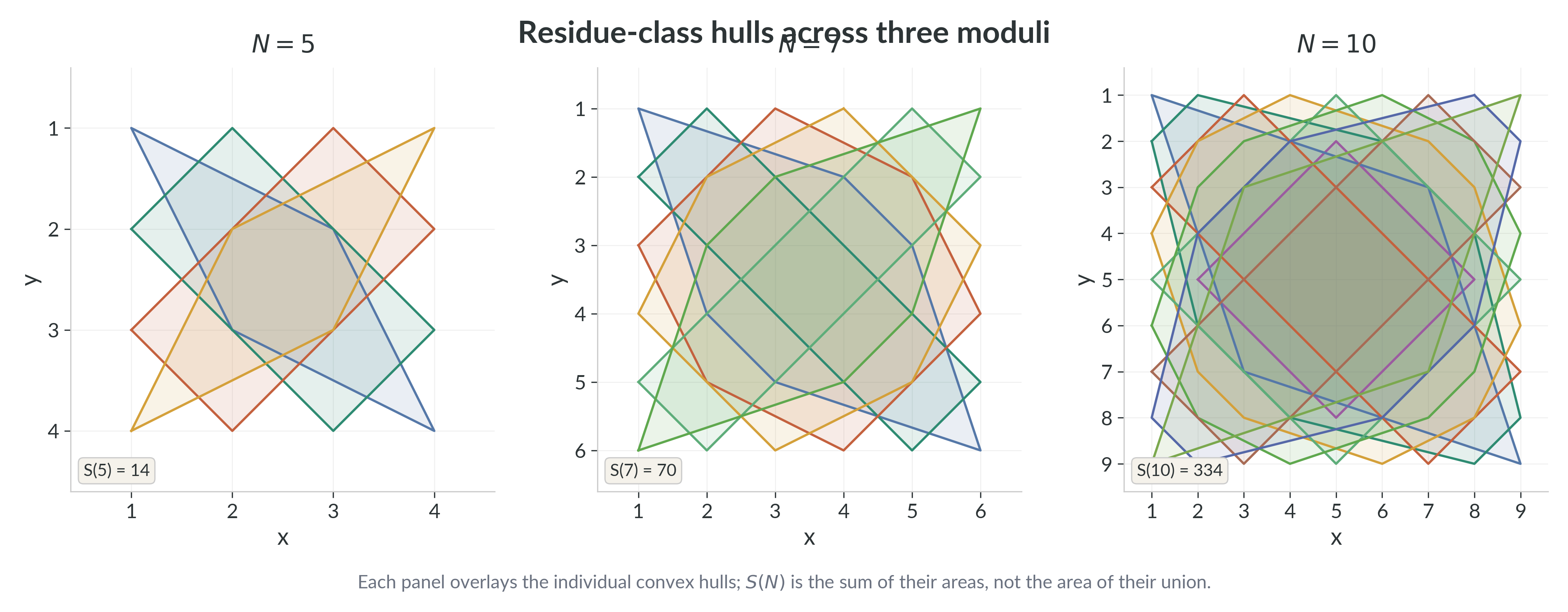
Each residue label $a \in \{0,1,\ldots,N-1\}$ determines the lattice set A_N_a, and the main geometric quantities are $$ S(N,a) := \operatorname{Area}(\operatorname{conv}(A_{N,a})), \qquad S(N) := \sum_{a=0}^{N-1} S(N,a). $$ So MTMN starts from finite arithmetic data and develops it into residue classes, convex polygons, and area invariants.
Core Reading Path
The main public route through the subject is:
- the residue classes A_N_a
- the per-residue and total areas S_N_a and S_N
- the solved composite-side zero class zero_class_geometry
- the exact boundary models first_boundary_model and second_boundary_model
Two early structural contrasts
Two contrasts organize the current theory from the start.
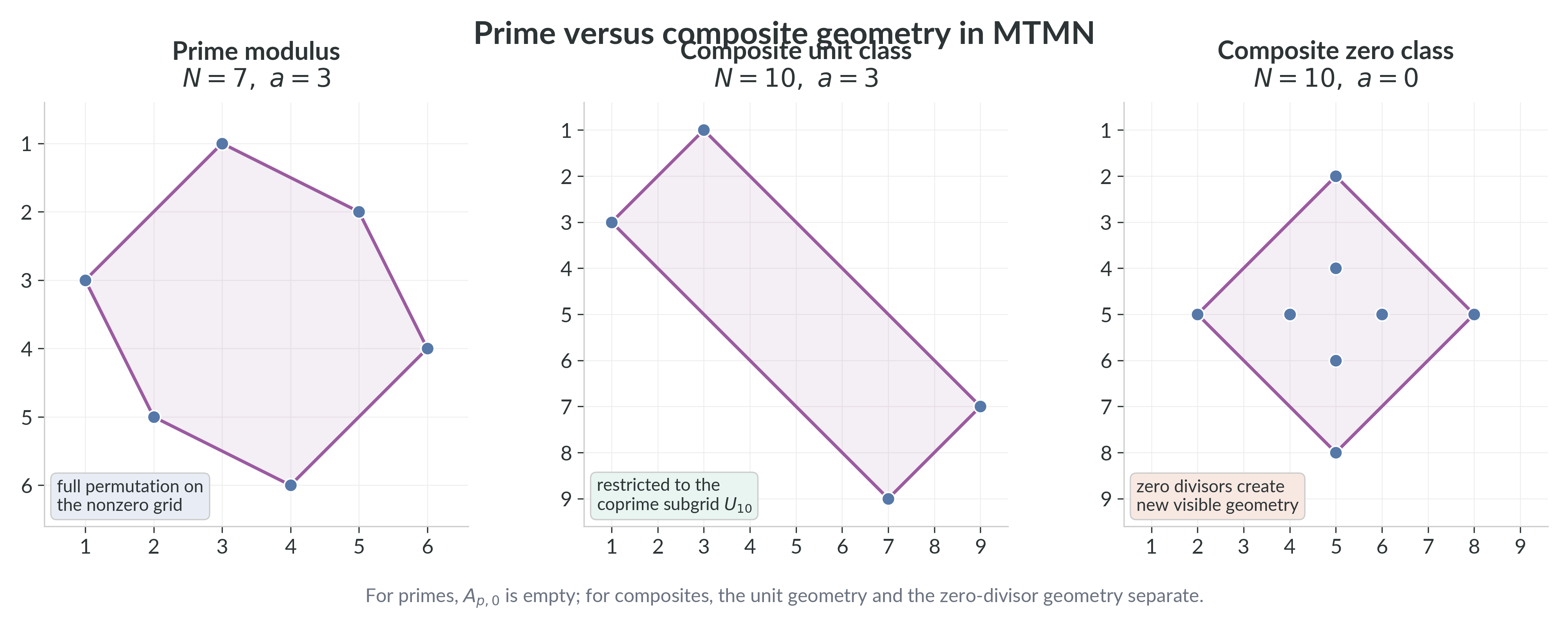
First, prime and composite moduli behave differently. Prime nonzero residue classes form the clean permutation-plot case, while composite moduli split into a unit-side geometry and a visible zero-divisor geometry. The zero class is the first place where the composite side becomes completely explicit; see zero_class_geometry.
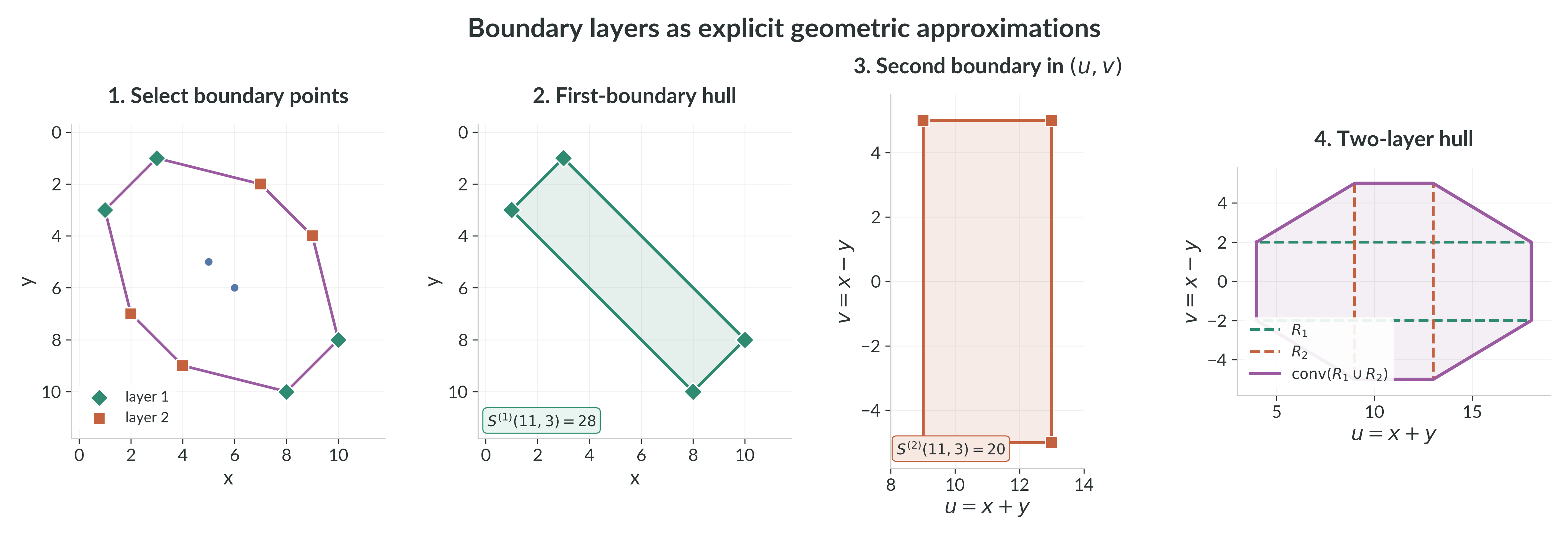
Second, the table is naturally built border by border. Those visual layers already produce the exact lower models first_boundary_model and second_boundary_model.
Figures
Related Concepts
- A_N_a — the residue-class point sets
- small_examples_atlas — the first worked examples $N=5$ and $N=6$
- S_N_a — per-residue convex-hull area
- S_N — total area sum
- modular_hyperbolas — literature term for one residue class
- zero_class_geometry — first fully solved composite-side geometry
- first_boundary_model — exact outer-layer model
- second_boundary_model — exact odd-$N$ second-layer model
Tags
#definition